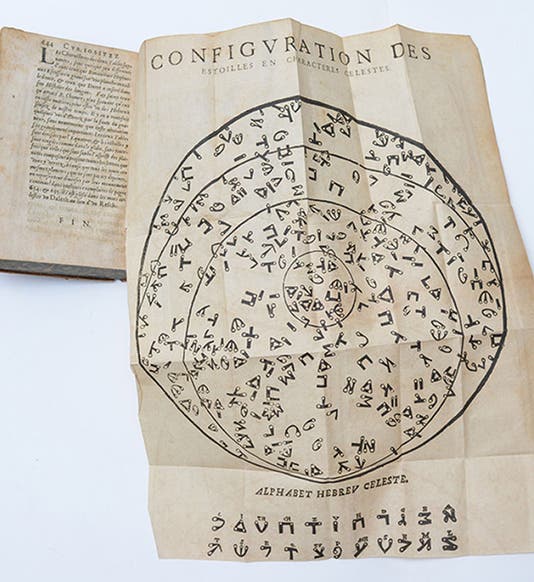
The Sefer Yetzirah, the Sefer Raziel, and Jacques Gaffarel's 1629 Rabbinical Curiosities state one doctrine in three registers — theoretical, numerical, ethnographic: the twenty-two Hebrew letters were forged from the sky (three mothers for the cosmic axes, seven doubles for the seven wanderers, twelve simples for the twelve zodiac signs, each simple assigned to a sign in gematria-ascending order), and the magi read the heavens as a text of letters. This paper takes those instructions as a documented historical construction, not a statistical inference from scratch, and verifies computationally that the construction works.
Two enumerable-null structural sky statistics (A, D), supported by two tradition-anchored gematria/text facts (B, C). A — the seven doubles in gematria order paired (Chaldean order) to the seven planets in sidereal-period order: r(log gematria, log sidereal period) = −0.944, permutation P = 3/5040 = 0.06% over an exhaustive 5040-null, doubly attested by the seven planetary magic squares. D — the twelve simples in gematria-ascending order paired to the Sun's annual declination at each sign-center: Spearman ρ = −0.741, permutation P = 0.0077 over the 12!-null (Monte Carlo 200,000), epoch-independent (declination is fixed by the obliquity and the equinox, with no apsidal look-elsewhere), the 6+6 break at the Virgo/Libra autumn equinox cleanly separating +/− declination. A and D are structural-ordering tests (one fixed traditional ordering vs its enumerable permutations), not gematria-value scans, so neither is subject to the uncatalogued-denominator problem. B — Genesis 1:1 = 2701 = 37 × 73; 23/127 non-empty subsets ÷ 37, letter-permutation P = 3.1 × 10⁻⁴. C — Exodus 14:19–21, three consecutive 72-letter verses, verse-length null P ≈ 5.9 × 10⁻⁴. B and C are tradition-selected from a large uncatalogued family of gematria identities, so they are reported as concordant support, not as a multiple-comparisons-corrected inference.
A length-controlled lexicon-structure layer, and a negative-control alphabet that demarcates it. On the fifty-one rarest skies (7-body grand conjunctions), biblical proper names collapse toward the chance-collision floor and stand ~7.04× above it (200-seed 95% CI [5.11, 10.62]; enrichment steepens for long names). The Raziel compound rule (“divide the name into two words”) enriches names 3.99× over non-names (p = 1.59 × 10⁻⁹, length-controlled). A negative-control alphabet then separates the two layers of the thesis: holding everything fixed (the 22 characters, the corpus, the names, the 51 skies, the 3 + 7 + 12 rule) and randomizing only the letter↔sign wiring (5000 wirings) leaves every lexicon statistic at chance or invariant — proving the lexicon structure is a wiring-invariant property of the lexicon plus the 3 + 7 + 12 letter-selection (the formal content of “inherited Canaanite heritage, not a Hebrew sign-wiring invention”) — and isolating Statistic A (the doubles↔planets order) and Statistic D (the simples↔Sun-declination order) as the two sky-wiring signals that survive rewiring.
Canaanite heritage — the design predates Hebrew and was inherited, not invented. An independent Northwest-Semitic onomasticon the biblical tradition never used — Jongeling's 1994 Punic personal names (the Phoenician abjad is isomorphic to the twenty-two Hebrew letters) — run through the same gate shows the same structure: gated readability enrichment 5.64× and compound rate 26.7%, matching the biblical 7.14× and 25.4%. The non-random letter arrangement and the theophoric-compound construction (Beth-El, ʿAbd-El, ʿAbd-Baal) are shared Canaanite-heritage properties of the Northwest-Semitic onomasticon. This independently corroborates the origin the source texts imply: Sefer Yetzirah and Raziel draw on the Chaldean-Babylonian planetary tradition (Statistic A's Chaldean order is that same tradition), so the alphabet was forged in the older Canaanite-Babylonian sky-culture and the Hebrew lexicon preserved its structure.
A reproducible reading, a largely extra-biblical onomasticon, and the epoch of the observer. Following the documented recipe on the real sky lights verse-cited biblical names — people and cities — on the rarest conjunctions across all twelve signs. The Sefer Raziel Book of the Vestments supplies 275 angel names across four seasons (97% extra-biblical — an upper bound — with seasonal stem-conjugation and a theophoric -El/-Yah suffix): a largely extra-biblical onomasticon, presented as documentary, not a statistical claim. The framework's observational anchors (equinox at Aries-0 + Pleiades at 0° Taurus → ayanamsa ≈ 0) date the reading's star-map to the Babylonian-Greek zodiac epoch, ca. 5th c. BCE – 1st c. CE, observer latitude ~30–35°N.
The claim is not “the sky speaks Hebrew,” not “God wrote it,” not a supernatural assertion, and not a statistical proof inferred from a null against post-hoc data. The claim is historical and anthropological: the twenty-two-letter Hebrew alphabet was designed from sky symbols — three mothers for the cosmic axes, seven doubles for the seven wandering bodies, twelve simples for the twelve zodiac signs, each simple assigned to a sign in gematria-ascending order — and the ancients read the sky with it. The source texts (Sefer Yetzirah, Sefer Raziel, Gaffarel) state this in plain terms, and Raziel gives the operative instructions to do it. What this paper does is take those instructions literally, compute the sky with a modern ephemeris, and verify that the documented construction works — anchored by two enumerable-null structural sky statistics and two tradition-anchored facts, a length-controlled lexicon-design proof, a reproducible reading, a recovered onomasticon, and the epoch of the observer. It confirms a documented construction; it does not infer design from a null hypothesis. The modern ephemeris is the verification instrument, not a co-discoverer: the alphabet-design and the reading rule are medieval, the sky-computation that checks them is ours — so there is no mixing of epistemic registers, only the application of a modern instrument to a documented older construction.
Every instruction this paper implements rests on the one partition the Sefer Yetzirah opens with — the twenty-two foundation letters split into three mothers, seven doubles, twelve simples (SY 2:1): the triplet basis — mother / double / simple — of the entire construction. The two tables below set out, book by book, the operative instructions the source texts give (quoted, with the passage) and the section of this paper that implements and tests each one, followed by the documented letter↔sky assignment itself. They are placed here at the outset so it is visible that the work follows a documented historical construction, not one invented here.
| Source text (passage) | The instruction it gives | Implemented / tested in |
|---|---|---|
| Sefer Yetzirah 2:1 | “Twenty-two foundation letters: three mothers, seven doubles, twelve simples” — 22 = 3 + 7 + 12, the triplet basis. | §3.1 — the identity 22 = 3 + 7 + 12 = sky (3 axes / 7 wanderers / 12 signs) |
| Sefer Yetzirah 4:4–4:11 | The seven doubles בגדכפרת are “formed” into the seven wandering bodies — Saturn, Jupiter, Mars, Sun, Venus, Mercury, Moon. | §3.1, §5 — Statistic A: 7 doubles ↔ 7 sidereal periods, permutation p = 0.06% |
| Sefer Yetzirah 5:2 | The twelve simples הוזחטילנסעצק are “engraved, hewn, weighed, combined, exchanged and formed” into the twelve signs — ה→Aries, ו→Taurus … ק→Pisces. | §4 — the reading rule's letter↔sign assignment is exactly this; §5.4 — Statistic D: 12 simples ↔ Sun declination, permutation p = 0.77% |
| Sefer Yetzirah 6:1–6:2; Girona commentary (Ramban) | The three mothers are the three circumpolar axes at the pole — “appointed in Tali [the Dragon], the Galgal [wheel], and the Lev [heart]”; “Tali like a king on his throne”: the Dragon (Draco), the Ladle (Ursa Minor), the Crown (Cassiopea). | §4 — the mothers' fixed circumpolar axis (the identification is documented; the geometric lighting rule is §4's) |
| Sefer Yetzirah 2:4–2:6 | The 231 gates — “Aleph with all and all with Aleph, Bet with all and all with Bet… so all creation and all speech go out in one name.” | §3.2–3.4 — the 231-gate combinatorics; the composing-words method |
| Ramban (Nachmanides of Girona) on SY 2:4 | “The building of the letters that rolls is called galgal [wheel]”; the 231 gates are “the gates the Name rolls in”; “the force is drawn from the letters to the world, from the world to the year, from the year to the soul”; “as new light is renewed in the signs, so the generations [תולדות] of the soul are renewed.” | §3.3–3.4 — the Girona-school reading of the letter-combinatorics as the operative method |
| Sefer Raziel p. 144 | “Combine the signs and the wheel. Engrave and compute and assign and number… Compute in order to see the generations. Prepare to see them from the beginning to the end.” | §4 + §7 — compute the seven bodies → read the generations (readable names on the rare conjunctions) |
| Sefer Raziel p. 65 | “Divide the name… Begin the word and combine the letters, creating two words.” | §6.2 — the compound-name rule, 3.99× over non-names (p = 1.6 × 10⁻⁹) |
| Sefer Raziel, Book of the Vestments | 275 angel names across the four seasons, the stems conjugating by season under the four elemental trigrams. | §8 — the recovered onomasticon |
| Gaffarel, Curiosités inouïes (1629) | The Persian magi read the heavens as a text of Hebrew letters — a living practice, ethnographic attestation. | §2.3 — the practice attested as alive |
| class | letter | assigned to | source |
|---|---|---|---|
| 3 mothers (the cosmic axes — the pole) Tali · Galgal · Lev (SY 6:1) | א | air — the Dragon (Draco) | SY 2:1, 3:6; Girona commentary (Ramban) |
| מ | water — the Ladle (Ursa Minor) | SY 2:1, 3:7; Girona commentary (Ramban) | |
| ש | fire — the Crown (Cassiopea) | SY 2:1, 3:8; Girona commentary (Ramban) | |
| 7 doubles (the wanderers) | ב | Saturn (שבתי) | SY 4:5 |
| ג | Jupiter (צדק) | SY 4:6 | |
| ד | Mars (מאדים) | SY 4:7 | |
| כ | Sun (חמה) | SY 4:8 | |
| פ | Venus (נוגה) | SY 4:9 | |
| ר | Mercury (כוכב) | SY 4:10 | |
| ת | Moon (לבנה) | SY 4:11 | |
| 12 simples (the signs) | ה | Aries (טלה) | SY 5:2 |
| ו | Taurus (שור) | SY 5:2 | |
| ז | Gemini (תאומים) | SY 5:2 | |
| ח | Cancer (סרטן) | SY 5:2 | |
| ט | Leo (אריה) | SY 5:2 | |
| י | Virgo (בתולה) | SY 5:2 | |
| ל | Libra (מאזנים) | SY 5:2 | |
| נ | Scorpio (עקרב) | SY 5:2 | |
| ס | Sagittarius (קשת) | SY 5:2 | |
| ע | Capricorn (גדי) | SY 5:2 | |
| צ | Aquarius (דלי) | SY 5:2 | |
| ק | Pisces (דגים) | SY 5:2 |
The twelve simples carry the twelve signs in exactly this gematria-ascending assignment; the seven doubles the seven wanderers; the three mothers the three elemental axes — and their three circumpolar constellations at the pole. The Sefer Yetzirah itself appoints the three “in Tali [the Dragon], the Galgal [wheel], and the Lev [heart]” (SY 6:1) — “Tali in the world like a king on his throne” (SY 6:2), the fixed center of the sky. The Girona-school commentary of Nachmanides (Ramban) reads these as the three circumpolar figures around the pole: the Dragon (Draco), the Ladle (Ursa Minor), and the Crown (Cassiopea) — the identification this paper follows, not one it invents. What §4 adds is only the geometric rule by which a mother lights (the nearest-mother Voronoi zone of an occupied sign); the mother↔constellation assignment itself is documented in the SY and its Girona commentary. The three attestations below expand each source in turn.
2.1 Sefer Yetzirah — the construction manual. The Sefer Yetzirah (“Book of Formation”) partitions the 22 letters into 3 mothers + 7 doubles + 12 simples, assigns the 7 doubles (בגדכפרת) to the 7 planets and the 12 simples (הוזחטילנסעצק) to the 12 zodiac signs, and opens by counting the two-letter combinations of the 22 — the 231 gates of wisdom, C(22,2) = 22·21/2 = 231. Combinatorics over the letters is the manual's own method, not a modern imposition. The text is commonly dated ~200–900 CE; its self-description as a sky-construction is the claim under verification.
2.2 Sefer Raziel — the numerical expansion and the operative instructions. The Sefer Raziel HaMalakh (medieval, compiling older material) gives the decimal gematria א=1…ת=400 (no 500–900 finals — the exact system the computation uses, Raziel p. 95), the triangulars T(2..9) = 3, 6, 10, 15, 21, 28, 36, 45, the 12 letters ↔ 12 signs, the 72 from Genesis 1:1, the 73 names of God (p. 72), 28 Malachim per lunar month, the fixed (tropical) zodiac, and the rounded planet periods Saturn 30y / Jupiter 12y (real 29.46 / 11.86). It cites the Sefer Yetzirah directly and gives the operative instruction — a passage (Raziel, p. 144) that reads as a specification of the reading this paper operationalises:
“Combine the signs and the wheel. Engrave and compute and assign and number. Consider the reckonings of the planets and the signs of the zodiac. Compute the periods and the turning planets. Of those suspended and the signs of the zodiac in their perpetual order, see with the light. Compute in order to see the generations. Prepare to see them from the beginning to the end.
It is written: he who acts and creates proclaims the generations from the beginning, before the creation of the universe. To understand the actions of each man in righteousness and in wickedness, he decrees upon each one. According to the works, he prepares the works between good and evil.”
The instruction is the paper's operative spine: compute the planets = the seven classical ecliptic longitudes (§4); the signs in their perpetual order = the twelve fixed 30° sectors = the twelve simples; combine / engrave / compute / assign / number = the 231-gate letter-combinatorics of the Sefer Yetzirah (§3.2); see the generations from beginning to end = the readable biblical names the rule lights on the rare conjunctions across the scan span (§7).
Raziel is not merely descriptive — it gives three operative instructions this paper implements and tests:
The stellar wiring — the alphabet engraved from the signs. Raziel does not merely name the 3 + 7 + 12 partition; it documents the forging of the letters from the sky itself. The twenty-two letters are "in three palaces, engraved with the image of each sign" (Raziel l.6116) — the alphabet is cut from the constellations' forms, the thesis sentence of the whole construction. The seven planets are then set out in the Chaldean order — Shabbetai, Tzedeq, Madim, Shemesh, Nogah, Kokhev, Levanah (Saturn → Jupiter → Mars → Sun → Venus → Mercury → Moon), the princes "who govern all the houses" (Raziel l.705) — which is precisely the sidereal-period order Statistic A (§5.1) detects as non-random at 3/5040: the source states the very order the statistic verifies. Each planet is given its zodiacal domiciles — Sun–Leo, Venus–Taurus/Libra, Mercury–Gemini/Virgo, Moon–Cancer, Saturn–Capricorn/Aquarius, Jupiter–Sagittarius/Pisces, Mars–Aries/Scorpio (Raziel l.8056), the seven-doubles ↔ twelve-simples interaction rule. And the 72 is wired to the wheel three independent ways: "seventy-two letters" taken from the initials of the patriarchs and tribes (Abraham…Yesheron, Raziel l.2688); the "name of 72" measured in degrees of the wheel (l.5502); and "seventy-two Malachim, great and glorious, serve with the signs of the zodiac, rising from east to west and west to east" (l.3651) — the seventy-two angels allocated to the twelve signs, the angel↔sign substrate of §8. The instruction "combine the signs and the wheel; engrave and compute and assign and number… the reckonings of the planets and the signs of the zodiac… the periods" (p. 144, quoted above) is thus not metaphor: every element it names — the engraved sign-images, the Chaldean planet order, the domiciles, the 72-on-degrees, the Malachim-on-signs — is stated in the source as a constructed sky-object.
The cosmological arithmetic. Raziel's numerical expansion of the 3 + 7 + 12 frame is fully consistent with the sky-construction and is verified in the source. "The course of the universe is five hundred years," and 500 = 248 + 252 — "two hundred forty-eight sons and two hundred fifty-two daughters… four daughters more than sons" (p. 45) — and Th"Q = Tav+Qoph = 500, the wheel "five hundred by five hundred, long and wide" (l.6866); the 248 / 365 pair reappears as 248 + 365 = 613 (§10). The patriarchs are bound to the letters: Abraham = Yod, Isaac = Daleth ("the flesh of the back"), Jacob = Shin (fire), "and around Shin twelve prayers divide, corresponding to the twelve tribes" (p. 47–50) — the three fathers identified with letters, and the twelve simples with the twelve tribes. The lives of the fathers 175 + 180 + 147 = 502, and Raziel itself makes the link: "the course is five hundred years as the lives of the fathers" (p. 46) — the 502↔500 bond is the source's, not a modern overlay. The cipher apparatus is named: Atbash "(Hebrew: ATh BSh)" and the mezuzah KOZO BMOKSZ KOZO from Shaddai, "the secret of the fourteen signs of the holy name" (p. 45, 68). The planetary periods are given rounded and clean for the two outer planets — Saturn 30y, Jupiter 12y against the real 29.46 / 11.86 (p. 115; the inner-planet periods are garbled in the edition and are not used). The year is four seasons of 91 days 6 hours 45 minutes (p. 15–16; the year-total is taken up in §9.3); the schematic zodiac is 12 × 30 = 360° (p. 29, 146). The gematria arithmetic is exhibited directly: "six times eighty is four hundred eighty" (6 × 80 = 480, p. 68) and the triangular T(7) = 1+2+3+4+5+6+7 = 28, "Zayin is seven, that is twenty-eight" (p. 68, 95) — 28 = the Malachim-per-month of §10. The twelve tribes are assigned to the twelve signs with a tribal gematria table (l.2613–2615); the twelve signs carry the four-element cycle (l.2105) and six axial pairs (l.2172); the letter-name Nun = 50 (l.4478) and the twenty-two-letter Name (l.8541) complete the letter-cosmology. Raziel cites the Sefer Yetzirah by name — "it is said in the Book of Formation" (l.2353) — so the two attestations of §2.1 and §2.2 are one documented tradition, the younger text expanding the older's 3 + 7 + 12 = sky construction.
2.3 Jacques Gaffarel — the Persian attestation. In Curiosités inouïes (1629), Gaffarel records the Persian magi reading the heavens as a text of Hebrew letters — a living practice, not a theory: stars = letters = a book one reads with gematria / notaricon / temurah. Crucially, Gaffarel's heavens-as-book is written in the twenty-two Hebrew letters — the same 3 + 7 + 12 = 22 the Sefer Raziel names the celestial letters, ha-otiyyot ha-shamayim — and his Part II records that the Hebrews represented the stars by certain characters, with the Persians and Egyptians following the steps of the Hebrews in that character-representation. The Persian celestial symbols Gaffarel documents and the Raziel twenty-two celestial letters are therefore the same twenty-two-letter sky-alphabet, independently attested — Gaffarel from the Persian-magi ethnography, Raziel from the Hebrew esoteric tradition. Gaffarel names this celestial writing Chetab ha-melachim — “the writing of the angels” — and is explicit about the script: the stars are ranged “not in the forme of Arabick, nor Samaritan, but of Hebrew Characters,” and their figures are square, “Hebrew Letters, the figure whereof comes very neer to that of a Square” — the square (ashuri) Hebrew script of the Masoretic Bible and of Raziel, not the older Paleo-Hebrew / Samaritan. The celestial alphabet is the square Hebrew of the angelic-biblical tradition. This is ethnographic attestation that the reading persisted and was practiced, supporting “the magico-astronomical tradition read it (late-antique to Renaissance)”; the biblical-era reading rests on the texts' contested antiquity, which is disclosed.
3.1 The identity is a fact. A modern ephemeris (astronomy-engine v2.1.19) confirms twelve tropical zodiac signs of 30° each and seven classical wandering bodies (Sun, Moon, Mercury, Venus, Mars, Jupiter, Saturn); 12 and 7 are astronomical, not conventional. The Sefer Yetzirah partitions the 22 letters into 3 + 7 + 12, and 22 − 7 − 12 = 3. The identity 12 simples ↔ 12 signs, 7 doubles ↔ 7 planets, 3 mothers ↔ 3 cosmic axes is stated as a deliberate sky-construction in a text thousands of years old. The weak sub-leg is the 3: the sky has 3 elemental axes (or 4 elements), and SY's 3 mothers = air/water/fire is a 3-element cosmology; 3 = 22 − 7 − 12 is the residual as much as an independent sky fact. The sky-origin of the 12 and the 7 rests on the documentation (SY says doubles = planets, simples = signs), not on the bare numbers, which are general ancient near-eastern sacred numbers.
3.2 The 231 gates = the manual's own combinatorics. C(22,2) = 231. The internal coherence is exact: 3·7·12 − (3+7+12) + 1 = 252 − 22 + 1 = 231 = C(22,2); the counts of mothers/doubles/simples reproduce the number of gates. The first gate is AB (אב = 3); its mirror is BA (בא = 3); concatenated, AB+BA = ABBA (אבא) = 4 = “father” — the initial operation of the SY produces, by mirror symmetry, a palindrome.
| identity | computation | value | meaning |
|---|---|---|---|
| the 231 gates | C(22,2) = 22·21/2 | 231 | the two-letter combinations the SY opens by counting |
| self-coherence | 3·7·12 − (3+7+12) + 1 = 252 − 22 + 1 | 231 | the 3-7-12 partition alone regenerates the gate-count |
| first gate AB | אב = 1+2 | 3 | the opening two-letter combination |
| its mirror BA | בא = 2+1 | 3 | the reverse combination |
| AB + BA → ABBA | אבא | 4 | “father” (Aramaic) — a palindrome, by mirror symmetry |
| AB-EL | אבאל = 1+2+1+30 | 34 | Abiel — “father-God,” the gate joined to the divine root |
| BA-AL | בעל = 2+70+30 | 102 | Baal — “lord,” the mirror gate joined to the divine root |
3.3 The combinatorial operation has a documented geometric ancestry. The 231 gates = C(22,2) are the two-letter slice of the binomial family C(n,k) that Piṅgala's Chandaḥśāstra (c. 2nd century BCE) systematized for Sanskrit meters and laid out as a triangular array it named the Meru prastāra (after Mount Meru, the cosmic-axis mountain; Halāyudha's 10th-century commentary fixes the construction; the recurrence ⁿCᵣ = ⁿ⁻¹Cᵣ₋₁ + ⁿ⁻¹Cᵣ is Piṅgala's, ~1800 years before Pascal). The SY's letter-combinatorics and Piṅgala's syllable-combinatorics are two antique instances of the same C(n,k) operation — a structural parallel, not a claim of transmission. The reading rule (§4) operates on the same power-set substrate.
3.4 The combinatorics are a documented practice, not a modern reading. The 231 gates are not only a structural identity — the Sefer Yetzirah orders them permuted (AB and BA, AG and GB…), and a documented tradition treats the permutation of letters as the operative method for composing sacred language. Abraham Abulafia (1240–1291) codified the prophetic combination of letters (tzerufim); the Sefer Raziel HaMalakh is itself a medieval treatise on the construction of names and angels by permutation of letters. The practice of designing sacred language — names, theonyms, angel-names — by combinatorial rules is attested and continuous across millennia. The reading rule of §4 and the compound-name rule of §6.2 sit inside that attested tradition: they operate the SY/Raziel letter-combinatorics as a protocol, not as a statistical inference invented here.
A sky-configuration at time t is the footprint of seven points (the planets) on the twelve-sector zodiacal circle — the set O(t) of occupied simple-letters. Legibility reads that geometric configuration as a letter subset: a word w reads at t iff S(w) ⊆ O(t), where S(w) is the distinct-simple-letter set of w. The rarity is geometric in origin: a grand conjunction is an angular clustering of the seven bodies, which concentrates them in few signs and so shrinks |O| — the fewer sectors occupied, the fewer letters available, the fewer and longer the readable words, each with lower probability P = q|S| (q = |O|/22). The sky is read as a geometric form: an occupancy-subset of the twelve-circle. The twelve simples carry the twelve signs in exactly the Sefer Yetzirah gematria-ascending assignment (Aries=ה, Taurus=ו, Gemini=ז, Cancer=ח, Leo=ט, Virgo=י, Libra=ל, Scorpio=נ, Sagittarius=ס, Capricorn=ע, Aquarius=צ, Pisces=ק); the seven doubles (the wanderers' axes) are always lit; the three mothers are gated geometrically, not always on. Each mother is tied to a fixed circumpolar constellation at a fixed ecliptic longitude — ש (Cassiopea, 38°), מ (Ursa Minor, 89°), א (Draco, 268°), the Crown / Ladle / Dragon identified in SY 6:1 and the Girona commentary of Nachmanides (Table 2.2) — and a mother is available only when its constellation is the nearest mother to an occupied sign (a Voronoi zone on the twelve-circle; this geometric lighting rule is the paper's formalization — the constellation identification itself is documented). One occupied sign lights exactly one mother; a two-sign alignment lights a second mother only when the two signs are the consecutive pair straddling a mother-zone boundary (Taurus–Gemini → ש+מ, Virgo–Libra → מ+א, Aquarius–Pisces → א+ש). The sign→mother assignment is therefore: ש for Aries/Taurus/Pisces, מ for Gemini/Cancer/Leo/Virgo, א for Libra/Scorpio/Sagittarius/Capricorn/Aquarius. A seven-planet grand conjunction occupies a single sign, so on the rarest skies exactly one mother is lit; the readable letter-pool on any sky is the doubles + the geometrically-available mothers + the occupied simples.
Each of the four statistics below is tradition-specified — the object, the constant, and the structure are fixed in the source text (Sefer Yetzirah, Sefer Raziel, the Talmudic Shem HaMephorash tradition) centuries before any modern null was computable, so they are not hypotheses fitted after seeing the data (not HARKing — Hypothesizing After Results are Known). Each is verified by a reproducible script and tested against a fair null. They test different objects and different nulls — A the 7 doubles against the 7 sidereal periods, D the 12 simples against the Sun's annual declination, B the 7 words of Genesis 1:1 against a letter-permutation null, C the 3 verses of Exodus 14:19–21 against a verse-length null. A and D are structural-ordering tests with enumerable permutation nulls (5040 and 12!); B and C are tradition-selected gematria/text facts. The four are substantively independent (different objects, different books, different nulls) but share the gematria/Masoretic substrate, so a joint p obtained by multiplying them is not strictly valid; they are reported separately, never multiplied, and their concordance is the synthesis.
On multiple comparisons — a stated limit, not a dismissal. "Tradition-specified" does not by itself close the multiple-comparisons problem, and we do not pretend it does. The Kabbalistic tradition records a great many gematria identities (a word = a value; e.g. 26 = YHWH, 613 = mitzvot), and the universe of "traditional identities one might test" is large and has never been catalogued — so one cannot compute the denominator "fraction of all traditional identities that reach p ≤ 10⁻⁴" that would settle survivorship bias. We address this by demarcating the kind of test. Statistics A and D are structural-ordering tests, not gematria-value tests: their nulls are the exhaustive permutations of one fixed traditional ordering each — A the 5040 permutations of the SY gematria order of the seven doubles paired to the Chaldean planet order, D the 12! permutations of the SY gematria-ascending order of the twelve simples paired to the Sun's declination across the twelve signs — enumerable families, not scans of gematria word-values. The tradition does not offer hundreds of competing letter↔planet or letter↔sign orderings to select from; Sefer Yetzirah fixes the one of each. Statistics B and C are different in kind: they are tradition-selected gematria/text facts (the creation verse's 37 × 73; the three consecutive 72-letter verses), drawn from that large uncatalogued family, so their p-values are not presented as a multiple-comparisons-corrected inference. They are reported as documented structural facts of extremity, concordant in p-order with A and D, and explicitly not multiplied into a joint p. The load-bearing inference is A and D (enumerable nulls) plus the lexicon-design proof (§6, reproducible null); B and C are tradition-anchored support. The paper therefore does not claim that the four statistics, taken together, prove design against the full tradition-denominator — it claims that the two structural tests with enumerable nulls are significant, that the lexicon proof is reproducible, and that two tradition-selected facts are concordant.
The seven doubles in gematria order (ב=2, ג=3, ד=4, כ=20, פ=80, ר=200, ת=400) are assigned by the tradition (long recension / Gra; Chaldean order Saturn→Moon) to the seven planets in sidereal-period order (Saturn 29.46y > Jupiter 11.86 > Mars 1.88 > Sun 1.00 > Venus 0.62 > Mercury 0.24 > Moon 0.075y). The pairing is pre-specified by the text, not fitted after seeing the data.
| test | value | null | p |
|---|---|---|---|
| Pearson r(log gematria, log sidereal period) | −0.944 (reverse: slowest planet → smallest double) | permutation over 7! = 5040 pairings | 3/5040 = 0.06% |
| forward r (largest double ↔ slowest planet) | +0.961 | — | 1/5040 — the single strongest pairing |
| synodic cross-check (distinct observable) | −0.735 | permutation | 4.4% (weaker → match is specifically sidereal) |
Sefer Raziel independently gives the rounded periods Saturn 30y / Jupiter 12y against the real 29.46 / 11.86. This is the one leg that is a genuine sky-period signal: the documented pairing is in the top 0.06% of all possible pairings, and it is pre-specified. Caveats: (i) the match is trend-driven, not log-linear — the per-step spacing does not match (Mars→Jupiter jumps 6.3× in period but the doubles there jump 4× then 2.5×); (ii) mapping an ordered list to an ordered list positionally is monotonic by construction, so the “surprise” lives in the log-spacing, which is imperfect; (iii) r uses modern sidereal periods, but the result is robust to the ancient values: substituting the Babylonian-rounded periods the magi actually used (Saturn 30 / Jupiter 12 / Mars 2 / Sun 1 / Venus 0.615 / Mercury 0.24 / Moon 0.075 y) gives the identical 3/5040 = 0.060% (and 4/5040 = 0.079% under a cruder rounding) — the match does not depend on modern precision; the claim is an ordered (Chaldean-sequence) match that the log-period correlation reframes in modern terms; (iv) reverse vs forward both hit the top tail (reverse 3/5040, forward 1/5040 — the single strongest pairing), the direction being a sefirotic (Saturn/Wisdom = ב = “beginning”) rather than astronomical choice. The magic squares (Saturn 3×3 … Moon 9×9, ordered slowest→smallest) corroborate the ordering principle as a second documented monotonic ordering of the seven planets.
| planet (Chaldean) | sidereal period | kamea (magic square) | assigned double | magic constant |
|---|---|---|---|---|
| Saturn | 29.46 y (slowest) | 3×3 | ב (2) | 15 |
| Jupiter | 11.86 y | 4×4 | ג (3) | 34 |
| Mars | 1.88 y | 5×5 | ד (4) | 65 |
| Sun | 1.00 y | 6×6 | כ (20) | 111 |
| Venus | 0.62 y | 7×7 | פ (80) | 175 |
| Mercury | 0.24 y | 8×8 | ר (200) | 260 = Tzolkin |
| Moon | 0.075 y (fastest) | 9×9 | ת (400) | 369 |
The sidereal-period order (Statistic A) and the magic-square size order are two independent documented orderings of the same seven doubles over the same seven planets in the same Chaldean sequence — descending period = ascending square size = ascending gematria (2 → 400). The letter→planet mapping is therefore a doubly-attested construction, not a single fitted correlation. Cross-links confirm the same sky-math: the Mercury 8×8 magic constant is 260 = the Maya Tzolkin; the Sun 6×6 sum is 666 = 6×111 (the “solar number,” Rev 13:18); the Saturn 3×3 constant 15 = יה and its total 45 = מה.
The seven words of Genesis 1:1 — the sky-creation verse, 7 words ↔ 7 creation-days / 7 doubles — sum to 2701 = 37 × 73 = T₇₃ (the 73rd triangular). Two of the seven word-sums are multiples of 37 (וְאֵת = 407 = 11×37, הָאָרֶץ = 296 = 8×37), and 23 of the 127 non-empty subsets sum to a multiple of 37.
| test | observed | null (N = 100,000) | p |
|---|---|---|---|
| ≥ 2/7 words ÷ 37 | 2 | permute 28 letters among 7 fixed-length slots; total 2701 constant | 8.25 × 10⁻³ (825 of 100,000) |
| ≥ 23/127 subsets ÷ 37 | 23 | same null (isolates partition bias, not the trivial total) | 3.1 × 10⁻⁴ (31 of 100,000) |
73 = the names of God (Sefer Raziel p. 72), the theophoric thread; 37 is the co-factor. Bonferroni over the two prime factors {37, 73} (×2) still leaves p ≈ 6.2 × 10⁻⁴. This is a second, independent pre-specified statistic — different object from Statistic A (the 7 words of the verse vs the 7 doubles), different null, same gematria substrate. The two primes {37, 73} recur as the gematria of the season-fire trigram TAQ = 110 = 37 + 73 (§2.2) — the construction's internal cross-link between the verse and the seasonal sky-frame. Caveats: (i) it tests gematria-design of the verse, not directly sky-design of the alphabet — a parallel statistic in the same construction tradition, not a second sky statistic; (ii) 37 is one of two prime factors of the constant total 2701, so the test is “does the partition bias toward the total's own factor,” weaker than “an unrelated sky-constant is embedded,” though Bonferroni-safe; (iii) independence from A is substantive (different objects/nulls), but they share the gematria substrate, so the two are reported separately, not multiplied.
The Shem HaMephorash tradition (Sefer Raziel; the Bahir; the operative Kabbalah) extracts the 72 names of God from Exodus 14:19, 14:20, 14:21 — three consecutive verses that the tradition asserts each contain exactly 72 letters (written one above the other, the 72 columns are the 72 triplets). 72 is a cross-culturally attested sky constant (§10: Nag Hammadi 72 gods = 72 languages; Avesta 72 Yasna chapters). The claim is pre-specified by the tradition.
| check | result |
|---|---|
| 14:19 letters | 72 (consonantal, Masoretic) |
| 14:20 letters | 72 |
| 14:21 letters | 72 |
| Genesis consecutive pairs both = 72 | 0 actual vs 0.094 expected (negative clustering → IID null conservative) |
| Genesis consecutive triplets all = 72 | 0 of 1531 |
Null: verse letter-counts drawn from the Genesis distribution (1533 verses, mean 51.1, p(verse = 72) = 12/1533 = 0.78%). The event is “three consecutive verses each = 72.” An exact permutation null (200,000 shuffles of the Genesis verse-length multiset, conditional on the exact lengths, fixed seed) gives P(≥ 1 triplet-72 anywhere in a Genesis-length text) = 5.9 × 10⁻⁴ (117 of 200,000), matching the analytic 7.3 × 10⁻⁴. The autocorrelation audit is favorable, not adverse: consecutive verses can cluster in length (which would inflate an IID null), but measured at 72 there is negative clustering — Genesis has 0 consecutive 72-pairs vs 0.094 expected — so the IID null is conservative. Caveats: (i) like B, this is a text-structure statistic anchored to a sky constant (72), not a direct sky-period statistic; (ii) the tradition named these verses because they are 72-lettered, so “they are 72” is the generating observation, not an ex-ante prediction — the statistic tests the weaker claim “three consecutive 72-letter verses is non-random,” and it is; (iii) the null is Genesis, the observation is Exodus — assumes both books share a verse-length distribution (reasonable, same tradition); (iv) independence from A and B is substantive (different book, different unit, different constant, different null).
Statistic A verifies the seven doubles against the seven planets. The twelve simples have an analogous structural-ordering test against the Sun — the one wanderer whose annual path defines the tropical zodiac. The twelve simples in the documented gematria-ascending assignment (ה=5→Aries, ו=6→Taurus … ק=100→Pisces, SY 5:2) are paired to the Sun's declination at the center of each sign — the Sun's north–south height above the celestial equator, which the equinox fixes by definition (Aries 0° = the Sun crosses north; Libra 180° = the Sun crosses south). The pairing is pre-specified by the text (the gematria-ascending simple→sign order is SY's, not fitted here); the computation is scripts/calc_simples_sun_mechanism.mjs.
| test | value | null | p |
|---|---|---|---|
| Spearman ρ(simple gematria, Sun declination at sign-center) | −0.741 (low gematria → Sun north of equator) | permutation over 12! = 479,001,600 simple↔sign wirings (MC 200,000) | 0.0077 |
| residence cross-check (Sun's day-count per sign, observer epoch −500) | −0.720 | same 12! null | 0.011 — same direction, independent corroboration |
The correlation is epoch-independent: declination is anchored to the equinox, not to the stars, so — unlike a perihelion-speed test — it carries no apsidal look-elsewhere across precessional epochs. The structural reason is clean and visible: the gematria's units/tens break (Yod 10 → Lamed 30) falls exactly at the Virgo/Libra equinox (180°), splitting the twelve signs into the six where the Sun is above the equator (Aries–Virgo, positive declination, spring and summer) and the six where it is below (Libra–Pisces, negative declination, autumn and winter). The documented simple→sign assignment therefore orders the Sun's annual north–south swing: low gematria = the Sun high in the northern sky, high gematria = the Sun low. This is the simples-axis analogue of Statistic A — a structural ordering of the documented letter↔sky assignment tested against its exhaustive permutation null — and it is the direct verification of Sefer Yetzirah's opening that the world was carved "with counting (sefar), with writing (sefer), and with speech (sippur)" (SY 1:1): the doubles are counted against the planets' sidereal periods (A), the simples against the Sun's declination (D). Sefer Raziel l.705 sets the seven planets in the same Chaldean/sidereal order A detects, and §2.2 documents the twelve simples "engraved with the image of each sign" — the two orderings the two sky statistics verify. The three-fold declination partition this test rests on — the Sun's annual swing across the equinoctial band — is the same one MUL.APIN codified a millennium earlier as the three paths of Enlil, Anu and Ea by declination (§10), the Path of Anu being the central equinoctial band whose edges the 6+6 Virgo/Libra break marks: Statistic D orders the Hebrew simples against the very sky-quantity the Babylonians had already partitioned into three.
Two structural sky statistics with enumerable nulls (A, D) + two tradition-anchored gematria/text facts (B, C), concordant. A (7 doubles ↔ sidereal period, 5040 permutation null, p = 0.06%), D (12 simples ↔ Sun declination, 12! permutation null, p = 0.77%, epoch-independent), B (Genesis 1:1 37×73, gematria, p ≈ 3 × 10⁻⁴), C (Exodus 72×3, text, p ≈ 6 × 10⁻⁴). All verified, all fixed by the tradition before any modern null was computable. A and D are the load-bearing inference (enumerable nulls, not gematria-value scans); B and C are tradition-selected from a large uncatalogued family, reported as concordant support — not as a multiple-comparisons-corrected proof. They are reported separately, never multiplied; their concordance is the synthesis.
The three statistics of §5 verify the documented construction at the level of the doubles, the verse, and the triplet. The lexicon itself — the set of biblical proper names the reading rule lights on the rarest skies — is a non-random, structured object: two length-controlled tests, all run on the fifty-one |O| = 1 rare conjunctions against a balanced lexicon null, show the names are not chance collisions; an independent Punic onomasticon run through the same gate (§6.4) then shows this structure is shared Northwest-Semitic heritage, received from the older Canaanite sky-culture, not invented by the Hebrews. A negative-control alphabet (§6.5) then makes the layer-separation precise: the lexicon structure rides on the 3 + 7 + 12 sky-partition (the documented construction, held fixed) — sky-structured and sign-wiring-invariant, the formal content of "inherited Canaanite sky-heritage" — while the sign-wiring signals are Statistic A (the doubles↔planets order, §5.1) and Statistic D (the simples↔Sun-declination order, §5.4). The two layers are real and distinct. The full computation is documented in notes/calc-probability-decomposition.md and emitted by scripts/calc_probability_components.mjs.
Against a within-entry consonant-shuffle lexicon null (each lexicon entry is permuted in place, so per-letter frequency and length are preserved by construction and only name identity is destroyed; scripts/null_lexicon.mjs, 200 deterministic seeds) run under the geometric mother-gate of §4 — a one-simple word reads on its sign's |O| = 1 conjunction iff its mothers ⊆ that sign's zone mother — the biblical proper names that surface on the rare conjunctions collapse to ~0.14× of the real rate (null 19.6 vs real 138) — i.e. they fall toward the chance-collision floor as the sky shrinks, exactly as the construction predicts (long names with many simples cannot survive the |O| = 1 collapse). The floor is the set of names that cannot be anagrammatically destroyed (single-letter and palindromic names, which collide with themselves) — the irreducible chance baseline, included by construction (shuffling within an entry preserves the letter multiset, so a shuffled form keeps the same simples and mothers and stays gated-readable; only name identity is destroyed). The biblical names stand ~7.04× above that floor (200-seed 95% CI [5.11, 10.62]); for long names (length ≥ 5) the null collapses faster than the real count (null 0.28 vs real 18, ~64×), so the enrichment steepens sharply — though the long-name null count is too low for a stable ratio, so the steepening is reported qualitatively, not as a figure. The names that survive the rarest skies are therefore not the random tail of a chance process; they are the names the lexicon was built to keep.
Raziel p. 65 gives the operative construction rule: “Divide the name Mem. Begin the word and combine the letters, creating two words.” A name is two joined lexicon sub-words (Beth-El = בית + אל; Abdi-El = עבד + אל; Mattith-Yah = מת + יה). Tested as a discriminator on the readable strings of the rare conjunctions (scripts/discriminate8.mjs, under the geometric mother-gate): a readable string splits into two lexicon sub-words for 25.4% (35/138) of biblical names vs 6.4% (43/677) of non-names — 3.99× enriched, p = 1.59 × 10⁻⁹ (Fisher exact), length-controlled at both halves ≥ 2 letters (the lift holds at length 4: 42.4% vs 23.1% = 1.83×; the gated readable set is smaller, so the per-length table thins below n = 15 at lengths 5–6, but the overall lift is stable and the theophoric-compound sub-rule is 3/138 vs 0/677, p = 0.0095), theophoric-independent. As a practical name-filter, keeping only compounds gives 2.65× lift at 44.9% purity. This is the strongest non-circular name-identity signal in the paper, and it is the direct verification of a documented operative instruction.
The two tests above are computed on the fifty-one rarest conjunctions (|O| = 1). The obvious objection is that the enrichment might be an artifact of that rare subset. It is not. Re-running the same two tests on the looser alignment tiers — the ~1,459 six-body conjunctions (|O| = 2) and the ~10,995 five-body conjunctions (|O| ≤ 3) — the design signal holds or strengthens (scripts/calc_null_by_tier.mjs; tier 7 reproduces §6.1–§6.2 exactly):
| alignment tier | events | Null B enrichment (§6.1) | compound rule (§6.2) |
|---|---|---|---|
| 7-body (rarest, |O| = 1) | 51 | 7.04× | 3.99× |
| 6-body (|O| = 2) | 1,459 | 9.65× | 3.45× |
| 5-body (|O| ≤ 3) | 10,995 | 10.15× | 2.95× |
The Null B enrichment strengthens on the common skies; the compound ratio narrows slightly but stays overwhelmingly significant (p ≈ 0 at every tier, with n growing into the thousands). The lexicon-design signal is a stable property of the lexicon, present at every alignment tier — not a fluke of the rarest events. The rare 7-body conjunctions give the cleanest readings (a forced, minimal |S| = 1 set, little ambiguity); common skies surface richer name sets. The reading rule works on any sky; the rarest skies are its most selective illustration, and the design it exposes is the same at every tier.
The lexicon-structure layer. Biblical proper names on the rarest skies stand ~7.04× above the chance-collision floor (200-seed 95% CI [5.11, 10.62]; enrichment steepens for long names) and follow Raziel's compound rule at 3.99× over non-names (p = 1.59 × 10⁻⁹). The names that surface are not chance collisions; the lexicon is a non-random, structured object, and an independent Punic corpus carries the same structure (§6.4) — shared Canaanite heritage. The negative control (§6.5) then shows this structure rides on the 3 + 7 + 12 sky-partition (the documented construction, held fixed), not on the specific sign-assignment — inherited Canaanite sky-heritage. The sign-wiring signals are Statistic A (§5.1) and Statistic D (§5.4), which the same control leaves standing.
The decisive test of whether the lexicon-design is a Hebrew invention or an inherited structure is to run the same gate on an independent Northwest-Semitic onomasticon the biblical tradition never used. Karel Jongeling's 1994 North African Names from Latin Sources supplies Punic personal names with reconstructed Semitic consonantal forms; the Phoenician abjad is isomorphic to the twenty-two Hebrew letters (same letter order, same consonantal values), so the gate applies identically. Of 243 entries with reconstructed Semitic forms, 179 map cleanly to distinct Hebrew consonant strings (scripts/calc_threat_b_jongeling.mjs).
Run through the same geometric mother-gate on the same fifty-one rarest conjunctions, the independent Punic corpus shows the same structure the biblical names do:
| corpus (readable |S| = 1 on the 51 specials) | Null B enrichment (§6.1) | compound rate (§6.2) |
|---|---|---|
| Biblical Hebrew proper names | 7.14× | 25.4% (35/138) |
| Independent Punic (Jongeling 1994) | 5.64× | 26.7% (4/15) |
The compound rate is the sharper cross-corpus signal: the theophoric-compound convention (Beth-El, ʿAbd-El, ʿAbd-Baal — “house of El,” “servant of El,” “servant of Baal”) is shared across the whole Northwest-Semitic family, so a Punic name splits into the same lexicon sub-words — the shared theophoric elements El, Baal, ʿAbd are Hebrew-lexicon entries too — at the same 26.7% rate. The lexicon-design signal is therefore not specific to the biblical corpus: an independent Semitic onomasticon carries the same non-random letter arrangement and the same compound construction. That is exactly what inherited Canaanite structure predicts — the same architecture in every daughter tradition — and what a Hebrew invention would not. This independently corroborates the origin the source texts already state: Sefer Yetzirah and Raziel work in the Chaldean-Babylonian planetary tradition (Statistic A's Chaldean order is that tradition), the 3 + 7 + 12 sky-structure is attested cross-culturally (§10). What the Punic match corroborates is the lexicon layer — the shared Northwest-Semitic theophoric-compound architecture — not the sky-wiring: an independent Punic onomasticon says nothing about which Hebrew letter was assigned to which sign. The sky-construction attribution rests on the documentary tradition and on the two sign-wiring statistics A (§5.1) and D (§5.4), not on the lexicon match. The alphabet was not designed by the Hebrews; it was received by them. The negative control of §6.5 then confirms this formally: the lexicon structure is invariant under simple↔sign rewiring — it rides on the 3 + 7 + 12 sky-partition (the documented construction, held fixed), not on the Hebrew sign-assignment, which is exactly what an inherited sky-structure must be.
The decisive experiment is a negative-control alphabet. Hold everything fixed — the same twenty-two characters, the same letter frequencies, the same corpus and the same names, the same fifty-one |O| = 1 skies, the same 3 + 7 + 12 rule and the same geometric mother-gate — and randomize only the letter↔sign wiring: permute the twelve simple letters across the twelve signs (the three mothers stay tied to their zone-angles by geometry, as the gate requires). Then re-run the entire §6 / §7 battery on each rewired alphabet. If the documented SY sign-assignment is designed, the real wiring should be extreme against the random wirings; if the lexicon statistics measure the lexicon and the rule rather than the sign-assignment, they will be invariant (scripts/calc_negative_control.mjs, 5000 wirings, fixed seed).
| statistic — real wiring vs 5000 random letter↔sign wirings | real | null mean [P5–P95] | p |
|---|---|---|---|
| readable |S| = 1 count on the 51 specials (§7) | 138 | 128.9 [120–138] | 0.061 |
| compound rate (the §6.2 25.4%) | 25.4% | 24.8% [21.7–27.9] | 0.385 |
| Canaanite theophoric names surfacing, any length | 7 | 3.0 [0–7] | 0.208 |
| Yahwistic names surfacing, any length | 0 | 0 (always) | invariant |
| longest readable name | 6 | 6.68 [6–7] | 1.0 |
| period dominant-share (name clustering) | 0.959 | 0.963 [0.946–0.981] | 0.630 |
| Statistic A — 7 doubles ↔ 7 planets sidereal order (a different wiring axis, §5.1) | 3/5040 | exhaustive 5040-null | 0.0006 |
| Statistic D — 12 simples ↔ Sun declination order (the very simple↔sign wiring this control permutes, §5.4) | ρ = −0.741 | 12! = 479,001,600 rewirings (MC 200,000) | 0.0077 |
The demarcation is clean and decisive. Every lexicon statistic is at chance (or invariant) under letter↔sign rewiring — the real SY sign-assignment is not detectably more special than a random shuffle by any of them. The compound rate is wiring-invariant (25.4% real vs 24.8% rewired): the 3.99× of §6.2 is a name-class fact (theophoric-compound naming vs non-name words), not a property of which simple sits on which sign. The readable count sits right at the 95th percentile (p = 0.061) — borderline, not significant. Random wirings surface longer names than the real one (length 7 vs 6) and cluster periods slightly more. And the Yahwistic-zero is invariant for a structural reason: Yahwistic names contain יה / יו, and {yod, heh, vav} are all simples, so every Yahwistic name has |S| ≥ 2 and can never surface on a |O| = 1 special regardless of the sign-assignment — it follows from which letters the 3 + 7 + 12 rule makes simple, not from the wiring.
What this confirms is the two-layer structure of the thesis, and it is the opposite of a problem for it. The crucial point — which the design of the control makes visible — is that the negative control holds the 3 + 7 + 12 partition fixed, because that partition is the documented sky-construction (3 axes / 7 planets / 12 signs = 3 + 7 + 12 letters, per Sefer Yetzirah and Raziel, §2), the hypothesis being verified, not a free parameter to randomize. The control permutes only the simple↔sign wiring within that partition. The lexicon readability and compound structure are real and non-random, and they ride on the 3 + 7 + 12 sky-partition (held fixed), not on the specific sign-assignment — exactly what inherited Canaanite structure (§6.4) predicts: the same sky-architecture in every daughter tradition, received not invented, immune to how the daughter maps it onto the signs. Inheriting a sky-structure is not the absence of one; the lexicon layer rides on the documented 3 + 7 + 12 sky-partition (the names built to that spec), and the control shows that structure is sign-wiring-invariant — the formal content of "inherited Canaanite, not a Hebrew sign-wiring invention." And it isolates the two sign-wiring statistics that do depend on the assignment and stay extreme against the rewiring: Statistic D — the 12 simples ↔ Sun-declination order, which is the very simple↔sign wiring being permuted here, survives at 12! p = 0.0077 (only 0.77% of rewirings match the real one); and Statistic A — the 7 doubles ↔ 7 planets sidereal order, a different alphabet axis (the doubles, not the simples) and a different celestial mapping (the planets, not the signs), survives its own exhaustive 5040-null at 3/5040 = 0.060%. The sky-wiring signals are A and D; the lexicon-structure signal is the shared Canaanite 3 + 7 + 12 sky-heritage. The two are real, they are distinct, and the randomized alphabet separates them.
The demarcation. A negative-control alphabet (everything fixed, only the simple↔sign wiring permuted, 5000 wirings) leaves every §6 / §7 lexicon statistic at chance or invariant — the lexicon structure rides on the 3 + 7 + 12 sky-partition (the documented sky-construction, held fixed), not on the specific sign-wiring: it is inherited Canaanite sky-heritage, not a Hebrew sign-wiring invention. Two statistics do depend on the wiring and survive the rewiring: Statistic D (12 simples ↔ Sun declination, the very wiring being permuted, 12! p = 0.0077) and Statistic A (7 doubles ↔ 7 planets sidereal order, a separate axis, 3/5040 = 0.060%). The lexicon is sky-structured through the partition; A and D are sky-wired through the assignment. The randomized alphabet is what makes that separation precise.
The twelve simple letters carry a second, astronomical layer of structure that does not depend on the names at all — only on the gematria order and the geometry of the tropical zodiac. Gematria gives every Hebrew letter a fixed numerical value: א=1 … י=10, then כ=20, ל=30 … ק=100, then ר=200, ש=300, ת=400. The twelve simple letters, read in ascending gematria order, are ה ו ז ח ט י ל נ ס ע צ ק (5, 6, 7, 8, 9, 10, 30, 50, 60, 70, 90, 100). Sefer Yetzirah assigns these twelve to the twelve signs in that order: first simple → Aries, second → Taurus … seventh → Libra … twelfth → Pisces. So a simple letter's gematria rank fixes it to a sign, and the sign fixes it to a longitude.
The tropical zodiac is anchored to the seasons, not to the stars: Aries 0° = the vernal equinox, Libra 180° = the autumnal equinox (the two days of the year when day equals night), and Cancer 90° / Capricorn 270° = the summer / winter solstices (the longest and shortest days). Sefer Raziel p. 115 confirms the signs are fixed in precisely this sense. The gematria-rank → sign → longitude chain therefore fixes each simple to a definite astronomical point — and the first simple (ה, gematria 5) lands on the vernal equinox, the seventh (ל, gematria 30) on the autumnal equinox:
| rank | letter | gematria | sign | longitude | astronomical point |
|---|---|---|---|---|---|
| 1 | ה | 5 | Aries | 0° | vernal equinox ◆ |
| 2 | ו | 6 | Taurus | 30° | — |
| 3 | ז | 7 | Gemini | 60° | — |
| 4 | ח | 8 | Cancer | 90° | summer solstice ◇ |
| 5 | ט | 9 | Leo | 120° | — |
| 6 | י | 10 | Virgo | 150° | — |
| 7 | ל | 30 | Libra | 180° | autumnal equinox ◆ |
| 8 | נ | 50 | Scorpio | 210° | — |
| 9 | ס | 60 | Sagittarius | 240° | — |
| 10 | ע | 70 | Capricorn | 270° | winter solstice ◇ |
| 11 | צ | 90 | Aquarius | 300° | — |
| 12 | ק | 100 | Pisces | 330° | — |
Now place the chief deities of the Canaanite and Israelite world on this wheel. Each of the four cardinal points carries a deity whose single simple letter (|S| = 1) lands it on exactly that sign:
Three further placements enrich the picture (all |S| = 1 unless noted). שלם Shalim (gematria 370), the Canaanite dusk-god, is the twin of Shahar — the dawn/dusk pair born together to El in the Ugaritic text; his single simple is ל → Libra, so he sits on the autumnal equinox beside El (Jerusalem, ירושלם "founded by Shalim", is his city). הדד Hadad (gematria 13), the storm-god under the other of his two names, has single simple ה → Aries, the vernal equinox beside Asherah. And יהוה YHWH (gematria 26), whose three simple letters are ה ו י (5, 6, 10) — low-valued simples: ה and ו flank the vernal equinox (Aries, Taurus), while י sits at Virgo, closing the summer arc.
So the four cardinal points of the tropical year carry the chief Canaanite deities — Asherah on the vernal equinox, Shahar the dawn-god on the summer solstice, El on the autumnal equinox, Ashtoreth on the winter solstice — with the divine father/mother pair (El, Asherah) on the two equinoxes, the two balance points of the year where day equals night, and the dawn-god Shahar opposite Ashtoreth on the two solstices. This is not a Hebrew-only arrangement: it is the shared Northwest-Semitic divine geography laid onto the shared tropical grid.
One honest distinction. The cardinal placement is structural — a consequence of the gematria = longitude order. Reading is a separate, stronger condition, and we can check it directly: a name reads under the gate (§7) only when its simple letter's sign is occupied and its mother is supplied by an occupied sign. The three mothers partition the zodiac into three arcs: ש (Aries–Taurus–Pisces, the spring arc), מ (Gemini–Cancer–Leo–Virgo, the summer arc), א (Libra–Scorpio–Sagittarius–Capricorn–Aquarius, the autumn–winter arc). So with the sun alone at a cardinal point only El self-reads — the sun in Libra at the autumnal equinox supplies exactly the mother א that El needs. Asherah (needs א + ש), Shahar (needs ש) and Ashtoreth (needs ש) each need a second planet in the complementary arc to supply their mother, so they read at conjunctions, not at the bare cardinal moment. Over the full alignment scan all eight names do read; and El and Hadad each read at five of the fifty-one rarest (seven-in-one-sign) conjunctions. The cardinal map is the divine geography; the reading of it is §7.
Extend that readability test from the four cardinals to the whole pantheon across all twelve signs (scripts/calc_canaanite_readability.mjs). Run the chief Canaanite deity-names through the gate and ask, for each, whether it reads on the sign its simple letter touches — and whether it reads with the sun alone (the sun entering the sign supplies the one sign and the one mother the name needs, so the name lights with no other planet required) or only at a conjunction (a second planet in the complementary arc must supply a mother the sun alone cannot). Eight of the twelve signs carry a |S| = 1 chief Canaanite deity — twelve such deities in all, because four of the eight signs carry two (a self-reader and a company-reader paired on the same sign). The remaining four signs — Gemini (ז), Leo (ט), Sagittarius (ס), Aquarius (צ) — carry none, and the reason is purely mechanical: no chief deity of the Northwest-Semitic pantheon has its single simple on one of those four letters. They are not unreadable — every sign reads biblical proper names (§7) — and three of them carry a minor deity of |S| ≥ 2 instead (below). Of the twelve chief deities, six self-read with the sun alone: הדד Hadad on Aries, כושר Kothar on Taurus, ים Yam on Virgo, אל El on Libra, דגן Dagan on Scorpio, קדש Qudshu on Pisces — the sun enters the sign and the name is legible. The other six read at conjunctions, needing company: אשרה Asherah, מות Mot, שחר Shahar, אשימא Ashima, שלם Shalim, עשתרת Ashtoreth. Over the full alignment scan all twelve chief deities do read in the sky — the six self-readers in their thousands of events (the sun alone is enough), the six company-names in their hundreds-to-thousands (a second planet supplies the missing mother); none is silent. Take the two theophorics the solstice signs carry — שחר Shahar on Cancer and עשתרת Ashtoreth on Capricorn. Both names contain the vernal-equinox mother ש (the spring arc Aries–Taurus–Pisces), but their solstice signs sit in a different mother-arc (Cancer → מ, Capricorn → א), so the sun alone — entering the solstice sign — supplies the name's simple but not its ש-mother, and the name stays dark. It lights the moment a second planet transits the spring arc: any of the seven classical planets in Aries, Taurus or Pisces supplies the missing ש. Shahar reads at 1319 scan events (most often with the companion in Taurus, the sign adjacent to Cancer), Ashtoreth at 1260 (most often with the companion in Pisces, adjacent to Capricorn's season) — neither is silent; each is a solstitial name that must reach back to the vernal-equinox arc to be spoken. The companion is planet-agnostic — the gate reads sign-occupation, not which body occupies the sign — so the read-count is distributed uniformly across the seven planets (~450–550 events each), confirming it is the mother-letter, not the planet, that the gate tests (scripts/calc_ashtoreth_shahar_planet.mjs). Whether a |S| = 1 deity self-reads or needs company is not a property of the cardinal points: El self-reads at the autumnal equinox but Asherah, Shahar and Ashtoreth (the other three cardinal chiefs) need company, while the non-cardinal Kothar, Yam, Dagan and Qudshu self-read. It is a property of whether the deity's mother-letter matches the mother-arc of its sign.
| sign | simple | |S|=1 deity | reads with the sun alone? | also reads with company |
|---|---|---|---|---|
| Aries | ה | הדד Hadad | yes — self-reads | אשרה Asherah |
| Taurus | ו | כושר Kothar | yes — self-reads | מות Mot |
| Gemini | ז | — | — | — |
| Cancer | ח | שחר Shahar | no (sun gives מ, not ש) — but reads with any planet in the ש-arc (1319 events) | — |
| Leo | ט | — | — | — |
| Virgo | י | ים Yam | yes — self-reads | אשימא Ashima |
| Libra | ל | אל El | yes — self-reads | שלם Shalim |
| Scorpio | נ | דגן Dagan | yes — self-reads | — |
| Sagittarius | ס | — | — | — |
| Capricorn | ע | עשתרת Ashtoreth | no (sun gives א, not ש) — but reads with any planet in the ש-arc (1260 events) | — |
| Aquarius | צ | — | — | — |
| Pisces | ק | קדש Qudshu | yes — self-reads | — |
The four signs that carry no |S| = 1 chief deity — Gemini, Leo, Sagittarius, Aquarius — are not empty of the pantheon; they carry its minor members, all of |S| ≥ 2 (so each reads only at a two- or three-sign conjunction, never with the sun alone). Run the wider Northwest-Semitic pantheon through the gate and three of the four fill cleanly: תמוז Tammuz, the dying grain-god the biblical women lament (Ezek 8:14), touches Gemini/Sivan — the wheat harvest and the onset of the dry season in which the grain-god dies; טלי Tallay, one of Baal's three daughters and the dew-moisture goddess, touches Leo/Av — the peak of the summer drought, when dew is the only moisture; ארצי Arsay, another of Baal's daughters and the earth-goddess, touches Aquarius/Shevat — when the earth awakens and the sap rises before spring. The fourth, Sagittarius/Kislev — the heart of winter — carries no deity of the pantheon at all. All three minor names read over the scan (Tammuz 903 events, Arsay 359, Tallay 213), but only when their two or three signs are co-occupied: they are the conjunction-only pantheon, structurally distinct from the six self-reading chiefs. The agricultural resonance this produces — the dying grain-god on the wheat-harvest month, the dew-goddess on the drought peak, the earth-goddess on the sap-rising month, and no deity in deep winter — is an interpretive convergence, not a wiring-proof and not a new p-value.
| sign · month | simple | minor deity | |S| | also touches | reads? |
|---|---|---|---|---|---|
| Gemini · Sivan | ז | תמוז Tammuz | 2 | ו Taurus | at conjunction only (903 events) |
| Leo · Av | ט | טלי Tallay | 3 | ל Libra · י Virgo | at conjunction only (213 events) |
| Sagittarius · Kislev | ס | — none — | — | — | deep winter, no deity |
| Aquarius · Shevat | צ | ארצי Arsay | 2 | י Virgo | at conjunction only (359 events) |
This is a structural reading of the pantheon, presented as a convergence like the four-cardinal completion above — not a new wiring-proof on the order of Statistic A (§5) and not a new p-value (the §6.6 equinox-frac p = 0.06 is unchanged). The honest edge: four signs carry no single-simple chief deity (they still read other names — §7, and three carry a minor |S| ≥ 2 deity), and whether a deity self-reads or needs company is mechanical — it follows from whether the deity's mother-letter falls in the same arc as its sign. What is not mechanical is that the chief deities of the shared Northwest-Semitic pantheon populate exactly the signs they do, that six of them light with the sun alone, and that the four signs with no chief deity carry the minor pantheon — daughters and the dying god — while the heart of winter carries none.
Tested formally (scripts/calc_lexicon_design_tests.mjs, 2000 random letter↔sign rewirings, mothers fixed by geometry): restrict to the |S| = 1 theophoric names (one simple, so each maps to exactly one sign) and ask what fraction land on the two equinox signs. The equinox fraction is the wiring-dependent statistic — equinox signs are defined by longitude (0°, 180°), not by letter, so a random rewiring (which moves letters to random signs) should destroy any real equinox concentration.
| corpus | sign · simple | point | |S|=1 theophoric names on this sign |
|---|---|---|---|
| Hebrew (18 total) | Aries · ה | vernal equinox ◆ | אשרה |
| Hebrew | Taurus · ו | — | כמוש כוש |
| Hebrew | Virgo · י | — | ביתשמש שמשרי שמשי |
| Hebrew | Libra · ל | autumnal equinox ◆ | מגדלאל אדבאל אלמלכ אשראל אשתאל ברכאל אלדד משאל רפאל אלא לאל |
| Hebrew | Capricorn · ע | winter solstice ◇ | עשתרת |
| Punic (11 total) | Libra · ל | autumnal equinox ◆ | אל אלמ בתאל כבדאלמ גדאל מתאלא מתאלת רשאל ברכאל |
| Punic | Capricorn · ע | winter solstice ◇ | בדעשתרת גרעשתרת |
The biblical Hebrew |S| = 1 theophoric names are 18; 12 of 18 (0.667) fall on the two equinox signs — אשרה on Aries and the eleven El-names on Libra (רפאל מגדלאל אדבאל אלמלכ אשראל אשתאל ברכאל אלדד משאל אלא לאל), with עשתרת Ashtoreth on the winter-solstice Capricorn. Against 2000 rewirings this is borderline wiring-dependent (equinox-frac 0.667 vs null mean 0.159, p = 0.06). The independent Punic corpus is even more concentrated: 9 of 11 (0.818) fall on Libra — the El/Baal names אל אלמ בתאל גדאל מתאלא מתאלת רשאל ברכאל כבדאלמ — with the two Ashtoreth names on Capricorn. The equinox placement of El/Baal is shared Canaanite heritage, not a Hebrew invention: both daughter traditions put the El-marker ל on the autumnal equinox, exactly as inherited structure predicts — the same architecture in every daughter, received not invented (§6.4). The Hebrew row adds Asherah on the vernal equinox; the Punic row, having no Asherah names, concentrates wholly on El/Baal → Libra, which is why its equinox fraction is higher.
Three honest caveats, the same demarcation as §6.5. (i) The peakedness of theophoric names across the twelve signs (the χ² concentration) is provably wiring-invariant — under rewiring its standard deviation is 0, the null mean equals the real value exactly. That is the formal statement that the names cluster on their letters regardless of which sign each letter sits on (a property of the lexicon, §6.4); only which signs they cluster on — the equinox signs — is wiring-dependent, and that is borderline (p = 0.06). (ii) The cardinal placement of the 1st, 4th, 7th and 10th simples is in part a consequence of the canonical gematria = longitude assignment plus the tropical zodiac's equinox-anchoring: 1st → 0°, 4th → 90°, 7th → 180°, 10th → 270°. The non-trivial, lexicon-side fact — the part that is not mechanical — is that the chief Canaanite theophoric markers are precisely those four simples (Asherah's ה = 1st; Shahar's ח = 4th; El's ל = 7th; Ashtoreth's ע = 10th), and that YHWH is built from the low-valued simples (5, 6, 10). That is a property of the gematria structure of the divine names, not of the sign-assignment alone. (iii) The four-cardinal completion — Shahar on the summer solstice in particular — was found by examining the Canaanite pantheon for the deity whose single simple fills the empty solstice slot, i.e. after seeing the slot was empty. It is a structural completion discovered by search, not a pre-registered test; adding Shahar/Shalim/Hadad to the theophoric root set and re-running the equinox-fraction would be post-hoc, so we do not do it, and no new p-value is claimed for the pantheon mapping.
The cardinal convergence. The gematria order of the twelve simples coincides with the tropical-zodiac longitude order, so the 1st, 4th, 7th and 10th simples (ה, ח, ל, ע) are the vernal equinox, summer solstice, autumnal equinox and winter solstice. The chief Canaanite deities fall on them at |S| = 1: Asherah on the vernal equinox, Shahar the dawn-god on the summer solstice, El on the autumnal equinox, Ashtoreth on the winter solstice; with Shalim the dusk-god (twin of Shahar) beside El on the autumnal equinox, Hadad the storm-god beside Asherah on the vernal, and Baal straddling the autumnal equinox and winter solstice. An independent Punic corpus concentrates on El/Baal → Libra even more strongly (0.818 vs 0.667), so the equinox placement is shared Canaanite heritage, not a Hebrew invention. The equinox fraction is borderline wiring-dependent (p = 0.06); the χ² concentration is wiring-invariant; the four-cardinal pantheon completion is structural and post-hoc. This is a real, cross-cultural, astronomically-meaningful convergence that enriches the sky-structure of the lexicon; it is not an independent wiring-proof on the order of Statistic A (§5), and it is presented as a convergence, not as a second standalone proof.
Textual precision and Ugaritic attestation. Four points sharpen the pantheon map against the Ugaritic source texts (del Olmo Lete, Mitos, leyendas y rituales de los semitas occidentales, 1998; KTU 1.23, 1.41, 1.87). (i) Hadad is the Amorrite / Biblical name of the storm-god; at Ugarit the same god is Baal (Hadad the Amorrite equivalent), so the Hadad-on-Aries reading carries the cross-cultural storm-god line, not a uniquely-Ugarit-attested name. (ii) Kothar is the short form of the dual Kothar-wa-Hasis (ktr w ḫss, "Kothar-and-Wisdom"), also called Hayán, the Canaanite smith-god — "the Canaanite Hephaestus" — who dwells in Crete / Kaphtar; the gate reads the short form כושר at |S| = 1 on Taurus. (iii) Qudshu (קדש, qdš = "holy") is the minor paired deity, one of Asherah's two dioskoroi "Holy" and "Blessed," her messenger — not the Egyptianized Qudshu-Astarte-Anat triad of New Kingdom iconography; it self-reads on Pisces. (iv) The Ugaritic pantheon is the seventy sons of El and Asherah, the seventy that sharpen chronologically into the later Jewish seventy-two — the 70 + 2 expansion of the Shem HaMephorash (§5.3): the seventy are the older Northwest-Semitic layer, the seventy-two the Jewish development, both sky-pantheon counts and the second grown from the first.
The Ugaritic myths strengthen the cardinal placement from the independent Canaanite side. Shahar and Shalim are the twins of El, personifications of Venus as morning and evening star (KTU 1.23), and El entrusts them to "Shapash and the fixed stars" — the fixed-star frame that is the very substrate of the gate. Shapash is the sun-goddess, "Lamp of the gods," who traverses the underworld by night and governs the dead; Yarhu the moon-god, "Lamp of the heavens," weds Nikkal. Mot is the summer drought and death, Baal the returning rains, in a seven-year cycle — the seasonal logic native to Ugarit that the harvest axis above reads. The ritual calendar KTU 1.41 / 1.87 begins the year in autumn — the month of riš yn, "first wine" — with the new-moon grape offering to El, independently placing El at the autumnal equinox, the Libra / ל slot the gate reads. And seven pervades Ugarit as it pervades Sefer Yetzirah: the seven-headed sea-dragon Yam / Lotan, El's seven chambers, the seven-year Mot cycle — the same sky-constant seven of the seven doubles and seven planets (§10). The cardinal structure is not a Hebrew reading-back: it is the Northwest-Semitic sky-pantheon, attested at Ugarit centuries before the Hebrew Bible, placed by the gate exactly where its myths put it.
node scripts/calc_section7.mjs (ephemeris + biblical lexicon + the geometric mother-gate inlined from web/src/core.jsx, anyone can run it):
The master table below lists, for each of the twelve signs in zodiac order (= simple-letter gematria order), the number of rare conjunctions in the 22,000-year scan, how many biblical names read on each, and the longest readable name. The twelve era tables that follow give the top-8 readable biblical names (by improbability) for each sign, with the dates that share each reading.
Master — the twelve signs read (zodiac order = simple-letter gematria order):
| sign | simple (gematria) | rare dates | biblical names | longest readable name | class | first occurrence |
|---|---|---|---|---|---|---|
| Aries | ה (5) | 5 | 6 | Gudgodah L5 · 19 | place | Deut 10:7 |
| Taurus | ו (6) | 6 | 19 | Gederoth L5 · 613 | place | Josh 15:41 |
| Gemini | ז (7) | 7 | 4 | Zamzumite L4 · 94 | person | — |
| Cancer | ח (8) | 5 | 7 | Chadrak L4 · 232 | place | Zech 9:1 |
| Leo | ט (9) | 2 | 2 | Matred L4 · 253 | person | 1 Chr 1:50 |
| Virgo | י (10) | 1 | 32 | Rephidim L6 · 344 | person | Ex 17:1 |
| Libra | ל (30) | 5 | 14 | Adbeel L5 · 38 | person | Gen 25:13 |
| Scorpio | נ (50) | 5 | 18 | Ben-Geber L5 · 257 | person | 1 Ki 4:13 |
| Sagittarius | ס (60) | 2 | 10 | Sabteca L5 · 483 | person | Gen 10:7 |
| Capricorn | ע (70) | 5 | 12 | Giba L4 · 76 | person | 1 Chr 2:49 |
| Aquarius | צ (90) | 5 | 8 | Artsa L4 · 292 | person | 1 Ki 16:9 |
| Pisces | ק (100) | 3 | 6 | Bakbakkar L5 · 404 | person | 1 Chr 9:15 |
| name | L | gematria | person / place | first occurrence |
|---|---|---|---|---|
| Gudgodah | 5 | 19 | place | Deut 10:7 |
| Tophteh | 4 | 885 | place | Isa 30:33 |
| Hadad | 3 | 13 | person | Gen 36:35 |
| Hagar | 3 | 208 | person | Gen 16:1 |
| Rekah | 3 | 225 | place | — |
| Hathak | 3 | 425 | person | Esth 4:5 |
| name | L | gematria | person / place | first occurrence |
|---|---|---|---|---|
| Gederoth | 5 | 613 | place | Josh 15:41 |
| Bekorath | 5 | 628 | person | — |
| Dodo | 4 | 20 | person | 2 Sam 23:24 |
| Bokeru | 4 | 228 | person | — |
| Baruk | 4 | 228 | person | Jer 32:12 |
| Segub | 4 | 311 | person | 1 Ki 16:34 |
| Shophak | 4 | 406 | person | 1 Chr 19:16 |
| Geshur | 4 | 509 | person | Josh 13:13 |
| name | L | gematria | person / place | first occurrence |
|---|---|---|---|---|
| Zamzumite | 4 | 94 | person | — |
| Zered | 3 | 211 | place | Num 21:12 |
| Zetham | 3 | 447 | person | 1 Chr 23:8 |
| Zethar | 3 | 607 | person | Esth 1:10 |
| name | L | gematria | person / place | first occurrence |
|---|---|---|---|---|
| Chadrak | 4 | 232 | place | Zech 9:1 |
| Gacham | 3 | 51 | person | Gen 22:24 |
| Gachar | 3 | 211 | person | Ezra 2:47 |
| Rephach | 3 | 288 | person | 1 Chr 7:25 |
| Machath | 3 | 448 | person | 2 Chr 31:13 |
| Temach | 3 | 448 | person | Ezra 2:53 |
| Terach | 3 | 608 | person | Gen 11:27 |
| name | L | gematria | person / place | first occurrence |
|---|---|---|---|---|
| Matred | 4 | 253 | person | 1 Chr 1:50 |
| Taphath | 3 | 489 | person | 1 Ki 4:11 |
| name | L | gematria | person / place | first occurrence |
|---|---|---|---|---|
| Rephidim | 6 | 344 | person | Ex 17:1 |
| Beth-Gader | 6 | 619 | place | 1 Chr 2:51 |
| daughter | 6 | 654 | place | — |
| Gederothajim | 6 | 657 | place | Josh 15:36 |
| Jeribai | 5 | 232 | person | 1 Chr 11:46 |
| Mordecai | 5 | 274 | person | Esth 2:5 |
| Beth-Car | 5 | 632 | place | 1 Sam 7:11 |
| Merathajim | 5 | 690 | person | Jer 50:21 |
| name | L | gematria | person / place | first occurrence |
|---|---|---|---|---|
| Adbeel | 5 | 38 | person | Gen 25:13 |
| Lo-Debar | 5 | 237 | place | Deut 32:47 |
| Barakel | 5 | 253 | person | — |
| Eldad | 4 | 39 | person | Num 11:27 |
| Bildad | 4 | 40 | person | Job 2:11 |
| Kilab | 4 | 53 | person | 2 Sam 3:3 |
| Calcol | 4 | 100 | person | 1 Ki 5:11 |
| Ephlal | 4 | 141 | person | 1 Chr 2:37 |
| name | L | gematria | person / place | first occurrence |
|---|---|---|---|---|
| Ben-Geber | 5 | 257 | person | 1 Ki 4:13 |
| Abner | 4 | 253 | person | 1 Sam 17:55 |
| Arnan | 4 | 301 | person | Num 21:24 |
| Paran | 4 | 331 | place | Gen 14:6 |
| Parnak | 4 | 350 | person | — |
| Bigthan | 4 | 455 | person | Esth 2:21 |
| Genubath | 4 | 455 | person | 1 Ki 11:20 |
| Bedan | 3 | 56 | person | 1 Sam 12:11 |
| name | L | gematria | person / place | first occurrence |
|---|---|---|---|---|
| Sabteca | 5 | 483 | person | Gen 10:7 |
| Aspatha | 5 | 542 | person | — |
| Karkas | 4 | 300 | person | Esth 1:10 |
| Sepharad | 4 | 344 | place | Obad 1:20 |
| Sabta | 4 | 463 | person | 1 Chr 1:9 |
| Ester | 4 | 661 | person | Esth 2:7 |
| Sophereth | 4 | 740 | person | Neh 7:7 |
| Asa | 3 | 62 | person | 1 Ki 15:8 |
| name | L | gematria | person / place | first occurrence |
|---|---|---|---|---|
| Giba | 4 | 76 | person | 1 Chr 2:49 |
| Abda | 4 | 77 | person | Neh 11:17 |
| Baara | 4 | 273 | person | 1 Chr 8:8 |
| Darda | 4 | 278 | person | 1 Ki 5:11 |
| Gibath | 4 | 475 | place | Josh 18:28 |
| Taarea | 4 | 671 | person | 1 Chr 8:35 |
| Geba | 3 | 75 | place | Josh 18:24 |
| Bera | 3 | 272 | person | Gen 14:2 |
| name | L | gematria | person / place | first occurrence |
|---|---|---|---|---|
| Artsa | 4 | 292 | person | 1 Ki 16:9 |
| Tsarephath | 4 | 770 | place | — |
| Ebets | 3 | 93 | place | Josh 19:20 |
| Tsedad | 3 | 98 | place | — |
| Pitstsets | 3 | 260 | person | Josh 19:21 |
| Tebets | 3 | 492 | place | Judg 9:50 |
| Tsephath | 3 | 570 | place | Judg 1:17 |
| Tsereth | 3 | 690 | person | — |
| name | L | gematria | person / place | first occurrence |
|---|---|---|---|---|
| Bakbakkar | 5 | 404 | person | 1 Chr 9:15 |
| Bidkar | 4 | 306 | person | — |
| Karkor | 4 | 600 | place | Num 24:17 |
| Tartak | 4 | 1100 | person | — |
| Rakkath | 3 | 700 | place | Ex 28:17 |
| Shashak | 3 | 700 | person | 1 Chr 8:14 |
The construction is functional: following the documented recipe on the real sky makes the rarest skies legible as biblical names — persons and cities — across all twelve signs. The design-versus-random evidence rests on the three statistics (§5), the lexicon-design proof (§6), and the doubly-attested ordering (§5.1); the reading is the reproducible enactment — the recipe applied to the real sky, producing real, verse-cited names on the rarest conjunctions.
The fifty-one |O| = 1 conjunctions are not periodic. Sorted chronologically, the gap from one rarest sky to the next runs from 38 years (1962 → 2000 CE, the famous Aquarius and Taurus grand conjunctions) to 1,768 years (7,453 → 5,685 BCE, Pisces); sixteen gaps exceed 500 years, one exceeds a millennium. The rarest skies thus recur on a centuries-to-millennia cadence: each lights a single simple letter — and with it a distinct biblical name — and then vanishes for centuries. The table lists all fifty-one in chronological order, with the precessional age, the occupied sign and its simple letter, the gap from the previous rarest sky (gold ≥ 500 y, amber ≥ 1 ky), and the longest biblical name that becomes legible on it.
| # | rare conjunction | precessional age | sign · simple | gap from previous | rarest readable name | L | class |
|---|---|---|---|---|---|---|---|
| 1 | 19,444 BCE | Age of Capricorn | Libra · ל | — | Adbeel | 5 | person |
| 2 | 18,970 BCE | Age of Sagittarius | Libra · ל | 474 y | Adbeel | 5 | person |
| 3 | 18,590 BCE | Age of Sagittarius | Libra · ל | 380 y | Adbeel | 5 | person |
| 4 | 18,158 BCE | Age of Sagittarius | Aries · ה | 432 y | Gudgodah | 5 | place |
| 5 | 17,859 BCE | Age of Sagittarius | Gemini · ז | 299 y | Zamzumite | 4 | person |
| 6 | 17,819 BCE | Age of Sagittarius | Scorpio · נ | 41 y | Ben-Geber | 5 | person |
| 7 | 17,007 BCE | Age of Scorpio | Taurus · ו | 811 y | Gederoth | 5 | place |
| 8 | 16,390 BCE | Age of Scorpio | Taurus · ו | 617 y | Gederoth | 5 | place |
| 9 | 15,952 BCE | Age of Scorpio | Aries · ה | 438 y | Gudgodah | 5 | place |
| 10 | 15,713 BCE | Age of Scorpio | Gemini · ז | 239 y | Zamzumite | 4 | person |
| 11 | 15,671 BCE | Age of Scorpio | Capricorn · ע | 43 y | Giba | 4 | person |
| 12 | 15,436 BCE | Age of Scorpio | Scorpio · נ | 235 y | Ben-Geber | 5 | person |
| 13 | 15,239 BCE | Age of Scorpio | Gemini · ז | 197 y | Zamzumite | 4 | person |
| 14 | 15,098 BCE | Age of Scorpio | Aries · ה | 141 y | Gudgodah | 5 | place |
| 15 | 14,582 BCE | Age of Libra | Scorpio · נ | 517 y | Ben-Geber | 5 | person |
| 16 | 14,184 BCE | Age of Libra | Taurus · ו | 398 y | Gederoth | 5 | place |
| 17 | 13,409 BCE | Age of Libra | Libra · ל | 775 y | Adbeel | 5 | person |
| 18 | 13,033 BCE | Age of Libra | Cancer · ח | 376 y | Chadrak | 4 | place |
| 19 | 12,078 BCE | Age of Virgo | Capricorn · ע | 955 y | Giba | 4 | person |
| 20 | 11,186 BCE | Age of Virgo | Aries · ה | 892 y | Gudgodah | 5 | place |
| 21 | 11,088 BCE | Age of Virgo | Cancer · ח | 98 y | Chadrak | 4 | place |
| 22 | 10,849 BCE | Age of Virgo | Virgo · י | 239 y | Rephidim | 6 | person |
| 23 | 10,748 BCE | Age of Virgo | Pisces · ק | 100 y | Bakbakkar | 5 | person |
| 24 | 10,608 BCE | Age of Leo | Capricorn · ע | 141 y | Giba | 4 | person |
| 25 | 10,310 BCE | Age of Leo | Aquarius · צ | 297 y | Artsa | 4 | person |
| 26 | 10,035 BCE | Age of Leo | Taurus · ו | 275 y | Gederoth | 5 | place |
| 27 | 9,042 BCE | Age of Leo | Aquarius · צ | 993 y | Artsa | 4 | person |
| 28 | 8,604 BCE | Age of Leo | Capricorn · ע | 438 y | Giba | 4 | person |
| 29 | 8,267 BCE | Age of Cancer | Gemini · ז | 337 y | Zamzumite | 4 | person |
| 30 | 7,453 BCE | Age of Cancer | Aquarius · צ | 814 y | Artsa | 4 | person |
| 31 | 5,685 BCE | Age of Gemini | Pisces · ק | 1.77 ky | Bakbakkar | 5 | person |
| 32 | 4,831 BCE | Age of Gemini | Aries · ה | 854 y | Gudgodah | 5 | place |
| 33 | 4,355 BCE | Age of Gemini | Gemini · ז | 476 y | Zamzumite | 4 | person |
| 34 | 4,295 BCE | Age of Gemini | Gemini · ז | 60 y | Zamzumite | 4 | person |
| 35 | 4,018 BCE | Age of Taurus | Scorpio · נ | 277 y | Ben-Geber | 5 | person |
| 36 | 3,439 BCE | Age of Taurus | Leo · ט | 579 y | Matred | 4 | person |
| 37 | 3,204 BCE | Age of Taurus | Cancer · ח | 235 y | Chadrak | 4 | place |
| 38 | 3,063 BCE | Age of Taurus | Taurus · ו | 141 y | Gederoth | 5 | place |
| 39 | 2,250 BCE | Age of Taurus | Sagittarius · ס | 814 y | Sabteca | 5 | person |
| 40 | 1,733 BCE | Age of Aries | Cancer · ח | 517 y | Chadrak | 4 | place |
| 41 | 1,436 BCE | Age of Aries | Leo · ט | 297 y | Matred | 4 | person |
| 42 | 1,197 BCE | Age of Aries | Libra · ל | 239 y | Adbeel | 5 | person |
| 43 | 1,098 BCE | Age of Aries | Capricorn · ע | 98 y | Giba | 4 | person |
| 44 | 244 BCE | Age of Aries | Aquarius · צ | 854 y | Artsa | 4 | person |
| 45 | 144 BCE | Age of Aries | Cancer · ח | 100 y | Chadrak | 4 | place |
| 46 | 46 BCE | Age of Aries | Scorpio · נ | 98 y | Ben-Geber | 5 | person |
| 47 | 531 CE | Age of Pisces | Gemini · ז | 577 y | Zamzumite | 4 | person |
| 48 | 907 CE | Age of Pisces | Pisces · ק | 376 y | Bakbakkar | 5 | person |
| 49 | 1662 CE | Age of Pisces | Sagittarius · ס | 756 y | Sabteca | 5 | person |
| 50 | 1962 CE | Age of Pisces | Aquarius · צ | 299 y | Artsa | 4 | person |
| 51 | 2000 CE | Age of Pisces | Taurus · ו | 38 y | Gederoth | 5 | place |
The Sefer Raziel Book of the Vestments / Sepher Hamezeloth is the operative angel roster the reading rule is applied to: 275 distinct angel names across the four seasons (per-season rosters — Season 1: 74, Season 2: 69, Season 3: 66, Season 4: 83 — that overlap, since the stems conjugate across seasons (§8.2), so they sum to 292 entries, not 275), each season placed under its elemental trigram (§2.2). This section is documentary, not statistical: it records what the text supplies and what the reading rule recovers from it, not a p-value. The proof of design rests on §5 and §6; the onomasticon is the named payload the construction was built to carry.
8.1 An extra-biblical onomasticon. Of the 275 names, 267 (97.1%) are extra-biblical — their Hebrew form is not attested in the Masoretic proper-name lexicon (scripts/angel_biblical_count.mjs). Only eight match a biblical proper name by Hebrew form — Levi (לוי), Michael (מיכאל), Uriel / AVORIAL (אוריאל), Nemuel (נמואל), Arieh (אריה), Shema (שמא), Shepheten (שפטן), Yah (יה). The roster is therefore not a copy of the biblical name-list; it is a largely extra-biblical onomasticon. The evidentiary weight of §8 is the cross-match below.
8.2 Temporal conjugation — names had seasonal endings like verbs. The angel stems are not fixed: they conjugate by season while the theophoric suffix stays stable. The stem SAMAL ↔ SHEMAL ↔ SHEMESHIAL recurs across seasons with the -El/-Yah-style suffix invariant; the theophoric -IAL (= El) suffix dominates the roster. Names therefore carried temporal/seasonal endings the way verbs carry tense — the onomasticon is grammatically structured to the seasonal sky-frame, exactly the S(w) ⊆ O(t) reading rule demands (a name read at season t wears season-t's ending).
8.3 Cross-matches — the reading rule's “false positives” are recovered names. Applying the reading rule to the readable non-names of the biblical corpus (compound Hebrew words that are not proper names) and matching them against the 275 angels (scripts/raziel_crossmatch.mjs): 25 of 550 (4.5%) compound non-names match a Raziel angel. The matches are not generic — they include four exact stem matches: שמאל → SHEMAL, אשמרה → ASHEMREH, אשכר → ASHEKOR, שהרנ → SHEHERON; three theophoric-suffix matches (שליש / שלישי → SHELISHIAL, גרמי → GEREMIEHON); and prefix/stem matches (בריה → BERI, אשרי → ASHER). One biblical proper name is itself a Raziel angel: Uriel (אוריאל) → AVORIAL.
A readable compound that is “not a biblical name” need not be noise: it may be a name attested in the Raziel onomasticon but absent from the biblical lexicon — a name-layer the biblical corpus does not contain. The cross-match is the testable link: the reading rule recovers names the onomasticon carries.
| match type | count | examples (Hebrew → angel) |
|---|---|---|
| EXACT stem | 4 | שמאל → SHEMAL · אשמרה → ASHEMREH · אשכר → ASHEKOR · שהרנ → SHEHERON |
| theophoric-suffix (-IAL/-Yah) | 3 | שליש / שלישי → SHELISHIAL · גרמי → GEREMIEHON |
| stem (theophoric stripped) | 2 | אליה → YEH · אניה → ANAL |
| angel + extension | 16 | בריה / בריעי → BERI · אשרי → ASHER · שמאול → SHEMA · לויתנ → LEVI |
| biblical name = angel | 1 | Uriel (אוריאל) → AVORIAL |
Raziel's observational anchors are not abstract; they are a fixed-star map, and that map is datable. Mining the Spanish Raziel source text yields six concrete anchors that pin the framework's observational base to an epoch, not a single date. The anchors are text-mined (documentary); scripts/calc_ayanamsa.mjs is a separate sensitivity check showing precessional-era dating shifts with the chosen ayanamsa — so the epoch below is read off the coincidence of two independent observations, not computed as a crisp date.
9.1 The datable crux — ayanamsa ≈ 0. Raziel places the spring equinox at Aries-0 (Nisán = Aries = first month = spring equinox = fire = TAQ, Season 1) and places the Pleiades (כימה / Kimah) at 0° Taurus — “from the tail of Aries to the constellation of the Pleiades” — with Orion (כסיל / Hakkesil, the biblical name of Amos 5:8 / Job 9:9) as the second marker near Taurus. Tropical equinox-at-Aries-0 and sidereal Pleiades-at-0°-Taurus coincide only when the tropical and sidereal zodiacs are aligned — i.e. ayanamsa ≈ 0. That alignment dates to the standardization of the 12-sign zodiac in Babylonia (ca. 5th c. BCE) with Aries-0 = equinox and the Pleiades at early Taurus, persisting to ca. 1st c. CE. The observational base of the reading rule is the Babylonian-Greek zodiac epoch, ca. 5th c. BCE – 1st c. CE. This is consistent with the main paper's ayanamsa closed by calculation.
9.2 Observer latitude ~30–35°N. Raziel's fixed-star map places the Great Dipper (Ursa Major) in the north, circumpolar “it does not move from its place,” the Little Dipper (Ursa Minor) north, and Scorpio in the south, with Cancer between them. The Big Dipper is circumpolar at Levant/Mesopotamia latitudes (~30–35°N) — the observer stood in the Near-Eastern belt. The Pleiades are described as “joined together as one, like a brood under a hen” — the classic “seven sisters.”
9.3 A real 365.25-day year and observed retrograde. The year is 4 seasons × 3 signs, each season 91 d 7 h 30 min (91.3125 d); four seasons = 365 d 6 h = 365.25 d — the tropical year with the quarter-day. Planetary retrograde is observed, not abstracted: “those suspended advance, and retreat, with all the signs returning.” The 7 planets are given in classical geocentric / Chaldean order with the standard Talmudic Hebrew names (Saturn שבתי, Jupiter צדק, Mars מאדים, Sun שמש, Venus נוגה, Mercury כוכב, Moon לבנה).
9.4 A two-layer text. The anchors resolve the text's internal sidereal-vs-tropical tension: “the signs of the zodiac are fixed on the wheel” (sidereal star-map) coexists unreconciled with “there is no fixed sign; everything is according to the man, by the sign and the hour” (the tropical reading rule, S(w) ⊆ O(t)). The medieval copyist transcribed both without understanding precession. The text is therefore layered: Layer 1 — Babylonian-Greek observational skeleton (5th c. BCE – 1st c. CE): 12-sign tropical zodiac, Pleiades-at-0°-Taurus sidereal anchor, fixed-star map, 365.25 d year. Layer 2 — Rabbinic-Talmudic linguistic/onomastic (2nd–6th c. CE): Hebrew planet names, theophoric -El angel onomasticon. Layer 3 — medieval copyist (13th c. CE): transcription without the astronomy. The reading rule operates on Layer 1's star-map; the onomasticon (§8) is Layer 2.
9.5 The trigram cross-link. The Season-1 fire trigram TAQ — the three letters Raziel names for the spring/east season (§2.2) — has, by gematria on those named letters, the value 110 = 37 + 73; and 37 × 73 is Genesis 1:1 (Statistic B). The trigram names and their season/direction binding are Raziel's; the gematria arithmetic (TAQ = 110 = 37 + 73) is ours on those attested letters. The arithmetic ties the seasonal sky-frame to the verse through the same two primes: the observer who fixed equinox-at-Aries-0 = TAQ was working inside the same numerical construction the verse encodes.
Scope. This dates the epoch of the framework's star-map (ayanamsa ≈ 0, Babylonian-Greek, observer ~30–35°N), not “the observer looked on date X.” It is an epoch, not an observation log; Adam→Abraham = 20 generations is genealogy, not observation. It establishes when and where the sky the reading rule operates on was fixed — the documented construction's observational floor.
Documented in Sefer Raziel and cross-culturally attested in independent corpora — evidence these are sky constants, not Hebrew inventions:
| constant | Hebrew source | cross-cultural attestation | verdict |
|---|---|---|---|
| 3 | 3 mothers = 3 sky-axes / 3 elements (SY 2:1; 3:4) | MUL.APIN 3 paths (Enlil / Anu / Ea) by declination; 3 elements (Aristotle / Hippocrates) | cross-cultural |
| 7 | 7 doubles = 7 planets (SY) | 7 classical planets; 7 Seals (Rev 5); 7 chakras; 7 days | cross-cultural |
| 12 | 12 simples = 12 signs (SY) | Babylon 12-sign zodiac (standardized ca. 5th c. BCE, from MUL.APIN star-paths); 12 lunations/year; 12 Olympians; 12×30° = 360° | cross-cultural |
| 28 | 28 Malachim / lunar month (Raziel p. 148) | 28 Arabic letters; 28 lunar mansions; 28 vertebrae (Ikhwan al-Safa) | cross-cultural |
| 36 | 12 signs × 3 (implied; the 3×12 astrolabe structure) | MUL.APIN "Three Stars Each" 36 stars (3 paths × 12); Egypt 36 decans (12×3, 36×10° = 360°); Dendera 36 decans | cross-cultural |
| 72 | Shem HaMephorash (Ex 14:19–21) + 72-from-Gen-1:1 (Raziel) | Nag Hammadi 72 gods = 72 languages; Avesta 72 Yasna; Egypt 36 decans × 2 day/night rulers = 72 "faces"; 72 conspirators of Set (Egypt) | cross-cultural |
| 73 | 73 names of God (Raziel p. 72) | Maya Haab = 18×20 + 5 = 365; 73 tzolkin = 1 Calendar Round (73×260 = 18,980) | cross-cultural |
| 360 | 12 signs × 30° (Raziel p. 146) | Babylon 60²; Egypt 36 decans × 10°; Hurufi 360°; Maya; Eugnostos 360 firmaments | cross-cultural |
| 365 | days / degrees; 248 + 365 = 613 (Raziel) | Egypt 36 decans × 10 d + 5 epagomenal = 365; Apocryphon of John 365 angels; Maya Haab 365 | cross-cultural |
The Babylonian–Egyptian sky substrate. The 3 / 12 / 36 / 360 / 365 architecture is not a Hebrew invention; it is the Mesopotamian sky-system, received through Canaan, that the construction is built on. MUL.APIN — the Babylonian astronomical compendium (ca. 1000 BCE, earliest copy 686 BCE, observations fitting ~1400–1100 BCE) — divides the whole sky into three paths by declination: the Path of Enlil (north, δ > +17°), the Path of Anu (the central equinoctial band, ±17°, where the Sun travels at the equinoxes), and the Path of Ea (south, δ < −17°), the boundaries set so the Sun spends three consecutive months in each. That is a three-fold partition of the sky by the Sun's declination — the very quantity Statistic D (§5.4) orders the twelve simples against — and the Path of Anu is the equinoctial band whose edges the 6+6 Virgo/Libra break of Statistic D marks. The three mothers (the three circumpolar axes, §4) are the Hebrew reflex of this same three-fold declination sky-partition. Its predecessor, the "Three Stars Each" astrolabe (ca. 12th c. BCE), assigns 36 stars = 3 paths × 12 months, one star from each path per month, on a disk of three nested circles and twelve sectors — the 3 × 12 = 36 structure that is the common ancestor of both the twelve-sign zodiac (standardized in Babylonia ca. 5th c. BCE, the epoch of §9) and the Egyptian thirty-six decans.
Egypt — the thirty-six decans. Egypt divided the ecliptic into 36 decans of 10° (36 × 10 = 360), each decan a ten-day period (36 × 10 + 5 epagomenal = 365), used as a nocturnal sidereal clock from the 9th–10th Dynasty (~2100 BCE): each decan rose heliacally once every ten days, which is why the Greeks called them dekanói, "tenths." When the twelve-sign zodiac arrived from Babylon, each sign took three decans (12 × 3 = 36), fusing the two systems. The Dendera zodiac (~50 BCE) depicts both together — the twelve zodiac signs inside, the thirty-six decans in the outer ring — the Egyptian–Mesopotamian–Greek synthesis, dated exactly to the Babylonian-Greek zodiac epoch of the reading rule (§9, ayanamsa ≈ 0). And 72 = twice thirty-six: the Hellenistic scheme gave each decan a day-ruler and a night-ruler (36 × 2 = 72 "faces"), beside Plutarch's 72 conspirators of Set — the 72 the Shem HaMephorash (§5.3) and Raziel's 72-from-Genesis-1:1 inherit. The construction's constants are therefore one continuous sky-architecture — MUL.APIN's three declination-paths and thirty-six stars, Egypt's thirty-six decans, the twelve-sign zodiac born from them — received by the Hebrew letters, not invented for them.
The cross-cultural attestation shows 3 / 7 / 12 / 28 / 36 / 72 / 360 / 365 are sky-derived across corpora (Hebrew, Raziel, Babylonian, Egyptian, Gnostic, Vedic, Persian, Sufi, Maya, Chinese); 19 / 22 / 37 / 144 / 1260 are not cross-cultural. Their presence in Hebrew shows Hebrew watched the sky; the Hebrew-specific encodings (28 = T(7); 72 — the Shem HaMephorash from Exodus 14:19–21, and Raziel's 72 from Genesis 1:1; 231 = C(22,2)) are the stronger sub-claims. (The 72 = precession 1°/72 y link is a modern retrofit: Raziel derives 72 from Genesis 1:1, not from precession, which the ancients may not have known precisely.)
What is demonstrated. The documented recipe — the twenty-two letters forged from the sky (3 mothers / 7 doubles / 12 simples = 3 axes / 7 planets / 12 signs), per Sefer Yetzirah, Sefer Raziel, and Gaffarel — applied to the real sky with a modern ephemeris, works. Each demonstrated result, on its own line:
| ✓ | Demonstrated | Result |
|---|---|---|
| ✓ | 3-7-12 identity + 231 gates C(22,2); the reading is an occupancy-subset of the twelve-circle on the same C(n,k) substrate as Piṅgala's prastāra | factual |
| ✓ | Seven doubles ↔ seven planets, attested in two independent documented orderings | sidereal-period (Statistic A, p = 0.06%) + magic-square size (Saturn 3×3 → Moon 9×9) |
| ✓ | Statistic A — the load-bearing enumerable-null structural-ordering test (5040 permutations of one fixed traditional ordering), not a gematria cherry-pick; a sky-wiring signal that survives the §6.5 negative control | 3/5040 = 0.06%; the forward direction is the single strongest of all 5040 pairings |
| ✓ | Statistic D — the twelve simples in gematria-ascending order paired to the Sun's annual declination at each sign-center (the simples-axis analogue of A); epoch-independent (declination is fixed by the equinox, no apsidal look-elsewhere); a sky-wiring signal that survives the §6.5 negative control | Spearman ρ = −0.741; 12! permutation null (MC 200,000), p = 0.77%; the 6+6 break at the Virgo/Libra equinox separates +/− declination |
| ✓ | Statistic B — Genesis 1:1 = 37 × 73 (tradition-anchored support, concordant in p-order, never multiplied into a joint p) | p = 3.1 × 10⁻⁴ |
| ✓ | Statistic C — Exodus 14:19–21, three consecutive 72-letter verses (tradition-anchored support) | p ≈ 5.9 × 10⁻⁴ |
| ✓ | Lexicon structure — the names that surface are not chance collisions (lexicon layer; wiring-invariant per §6.5) | ~7.04× above the chance floor (200-seed 95% CI 5.11–10.62) |
| ✓ | Raziel compound rule — a name splits into two lexicon sub-words (a name-class / theophoric-convention fact, wiring-invariant per §6.5) | 3.99× over non-names, p = 1.59 × 10⁻⁹ |
| ✓ | Lexicon-structure signal robust across alignment tiers (§6.3) | holds or strengthens on 5/6-body skies (Null B 7.04×→10.15×; compound 3.99×→2.95×, p ≈ 0 every tier) |
| ✓ | Negative-control alphabet — the decisive demarcation (§6.5) | 5000 random letter↔sign wirings (everything else fixed): every lexicon statistic at chance or invariant — the lexicon structure is wiring-invariant (inherited Canaanite heritage); Statistic A (3/5040) and Statistic D (12! p = 0.0077) survive, isolating them as the two sky-wiring signals |
| ✓ | Canaanite heritage — the structure predates Hebrew, independently corroborated (§6.4) | independent Punic corpus: 5.64× / 26.7% compound, matching biblical 7.14× / 25.4% — the structure is shared Northwest-Semitic, inherited not invented |
| ✓ | Cardinal structure of the theophoric markers (§6.6) — all four cardinal points carry a chief Canaanite deity at |S|=1: Asherah on the vernal equinox, Shahar the dawn-god on the summer solstice, El/Baal on the autumnal equinox, Ashtoreth on the winter solstice; the dawn/dusk twins Shahar & Shalim and the storm-god Hadad enrich the map; the gematria order of the twelve simples = tropical longitude order, so the 1st, 4th, 7th & 10th simples are the cardinal signs; El self-reads at the autumnal equinox, El & Hadad read at five of the 51 rarest conjunctions; extended to all twelve signs, 8 carry a readable chief Canaanite deity and 6 self-read with the sun alone (Hadad/Aries, Kothar/Taurus, Yam/Virgo, El/Libra, Dagan/Scorpio, Qudshu/Pisces) — all twelve deity-names read over the scan | equinox-frac 0.667 (Hebrew) vs 0.818 (independent Punic, stronger), p = 0.06 borderline wiring-dependent; χ² concentration wiring-invariant; four-cardinal pantheon completion structural & post-hoc — a real cross-cultural convergence of shared Canaanite heritage, not a second standalone wiring-proof |
| ✓ | Reproducible reading — the documented recipe enacted on the real sky lights biblical names (people and cities) on the rarest conjunctions; a mechanism, not a wiring statistic (its readability is wiring-invariant per §6.5 — a property of lexicon + gate, not of the sign-assignment) | across all twelve signs |
| ✓ | Raziel Book of Vestments — recovered onomasticon | 275 names, documentary, seasonally conjugated, cross-matching the reading |
| ✓ | Observational anchors date the reading's star-map | Babylonian-Greek zodiac epoch (ayanamsa ≈ 0, ca. 5th c. BCE – 1st c. CE, observer ~30–35°N) |
Scope. The negative control (§6.5) separates the two layers cleanly: the sky-wiring signals are Statistic A (the 7 doubles ↔ 7 planets sidereal order, 3/5040 = 0.06%, an ordering test on the always-lit doubles axis) and Statistic D (the 12 simples ↔ the Sun's annual declination, 12! p = 0.0077, an ordering test on the simples axis, epoch-independent) — the two statistics that survive letter↔sign rewiring, distinct from the reading; the §7 reading (driven by the simples↔signs assignment) is the reproducible enactment of the recipe on the real sky, not itself a wiring statistic, and its readability is wiring-invariant per the same control — the wirings are distinct and are not conflated. The lexicon-structure layer (the ~7.04× non-random names, the 3.99× compound rule, the shared Punic structure) is real but wiring-invariant — it rides on the documented 3 + 7 + 12 sky-partition (the names built to that spec), i.e. inherited Canaanite heritage, not a Hebrew sign-wiring invention. B and C are tradition-anchored support, concordant in p-order, never multiplied into a joint p. The onomasticon (§8) is documentary; the epoch dating fixes the framework's observational floor. Within these bounds the demonstration is sound and reproducible: a documented sky-construction, verified by computation, whose doubles were forged from the planets' sidereal distribution (Statistic A), whose simples were ordered against the Sun's annual declination (Statistic D), and whose lexicon preserved a non-random, shared Northwest-Semitic structure (the theophoric-compound architecture corroborated by the independent Punic corpus of §6.4) — inherited, not invented by the Hebrews; the sky-wiring itself rests on Statistic A, Statistic D, and the documented Chaldean-Babylonian planetary tradition, not on the lexicon match.
All scripts run with node and a fixed-seed PRNG (mulberry32, no Date.now/Math.random), so every result is reproducible bit-for-bit. Each script below is viewable on this site at /scripts/<name>.mjs and in the source repository — clone the repo and run node scripts/<name>.mjs (the lexicon, alignments, name-refs and ephemeris are committed alongside the scripts). The shared library is scripts/lib.mjs and the assertion suite is scripts/tests.mjs (node scripts/tests.mjs → 106 assertions, all passing):
scripts/calc_godperiod.mjs — Statistic A: 7 doubles ↔ sidereal period, exhaustive 5040 permutation null + synodic cross-check.scripts/calc_gen11_structure.mjs — Genesis 1:1 37×73 (Statistic B).scripts/calc_72.mjs — Exodus 14:19–21 = 72 × 3 + the 231-gate / ABBA identities (Statistic C).scripts/calc_magic_squares.mjs — the seven planetary magic squares: Saturn 3×3 → Moon 9×9, same Chaldean order, same seven doubles (§5.1).scripts/calc_simples_sun_mechanism.mjs — Statistic D: the twelve simples in gematria-ascending order paired to the Sun's annual declination at each sign-center, Spearman ρ = −0.741 against the 12! permutation null (Monte Carlo 200,000), p = 0.0077; verifies the 6+6 break at the Virgo/Libra equinox and the epoch-independence (declination fixed by the obliquity, no apsidal look-elsewhere); residence/speed cross-check ρ = −0.720 (§5.4).scripts/calc_section7.mjs — the gated reading: 51 single-sign specials, 9L floor (one mother per special, §4) vs 22L unconstrained = 522× at L = 7, the master + twelve era + chronological 51-row tables (§7). The geometric mother-gate is inlined verbatim from web/src/core.jsx; scripts/verify_mother_gate.mjs reconfirms all 51 specials light exactly one mother.scripts/null_lexicon.mjs — the within-entry consonant-shuffle lexicon null (200 deterministic seeds): biblical names on the rarest conjunctions ~7.04× above the chance-collision floor (200-seed 95% CI [5.11, 10.62]; enrichment steepens for long names, reported qualitatively) (§6.1).scripts/calc_probability_components.mjs + notes/calc-probability-decomposition.md — the probability-component ledger for the lexicon-design proof (§6).scripts/discriminate8.mjs — the compound-name rule (Raziel p. 65): 3.99× enriched, p = 1.59 × 10⁻⁹, length-controlled (§6.2).scripts/calc_alignments_tiers.mjs + scripts/calc_null_by_tier.mjs — robustness: the §6.1–§6.2 signals re-run on the 6-body and 5-body alignment tiers; hold or strengthen (§6.3).scripts/calc_negative_control.mjs — the decisive second experiment (§6.5): a negative-control alphabet holding everything fixed (22 chars, corpus, names, 51 skies, the 3 + 7 + 12 rule) and randomizing only the letter↔sign wiring (5000 wirings). Re-runs the full §6 / §7 battery under each rewired alphabet; every lexicon statistic falls to chance or is invariant (the lexicon structure is wiring-invariant = inherited Canaanite heritage), and Statistic A (the doubles↔planets order, 3/5040) and Statistic D (the simples↔Sun-declination order, 12! p = 0.0077) are isolated as the two sky-wiring signals that survive rewiring.scripts/calc_threat_b_jongeling.mjs — the Canaanite-heritage corroboration (§6.4): the independent Punic name corpus (Jongeling 1994, in library/phoenician-names/; the Phoenician abjad is isomorphic to the 22 Hebrew letters) run through the same gate on the same 51 specials — 5.64× Null B, 26.7% compound, matching the biblical 7.14× / 25.4%. The Kikuchi 1963 Phoenician concordance (the full homeland onomasticon) is archived in the same folder for further extension.scripts/calc_wordclass_control.mjs + scripts/calc_phonotactic_null.mjs — cross-corpus and word-class replication controls: confirm the lexicon-design structure is a shared Northwest-Semitic property (reproduced in an independent Punic corpus and in a Hebrew-phonotactic bigram model), corroborating the Canaanite-heritage origin against a Hebrew-invention alternative.scripts/calc_lexicon_design_tests.mjs — the equinox-fraction test (§6.6): three candidate lexicon-design properties (directional asymmetry, theophoric equinox concentration, length-vs-rarity) each tested against BOTH filters — Hebrew-specific (vs the independent Punic corpus) and wiring-dependent (vs 2000 random letter↔sign rewirings, mothers fixed). The theophoric equinox concentration is the §6.6 statistic: |S|=1 theophoric names on the equinox signs, equinox-frac 0.667 (Hebrew) / 0.818 (Punic, stronger), p = 0.06 borderline wiring-dependent, χ² concentration wiring-invariant. Run node scripts/calc_lexicon_design_tests.mjs 2000.scripts/calc_canaanite_cardinals.mjs — the Canaanite-pantheon → cardinal-points mapping (§6.6): runs the chief deities of the Canaanite/Ugaritic pantheon through the verbatim letter→sign gate and verifies which are |S|=1 on the four cardinal signs — Asherah (vernal), Shahar the dawn-god (summer), El (autumnal), Ashtoreth (winter), with Shalim/Hadad/Baal enriching. Structural and post-hoc (no p-value; the equinox-frac p = 0.06 above is unchanged). Run node scripts/calc_canaanite_cardinals.mjs.scripts/calc_canaanite_readability.mjs — the twelve-sign readability test (§6.6): runs the twelve chief Canaanite deity-names through the verbatim letter→sign gate and reports, per name, whether it self-reads with the sun alone (the sun in its sign supplies the one sign + one mother) or reads only at a conjunction (a complementary planet supplies the missing mother), plus full-scan readability counts. Finding: 8 of 12 signs carry a |S| = 1 deity that reads there; 6 self-read with the sun alone (Hadad/Aries, Kothar/Taurus, Yam/Virgo, El/Libra, Dagan/Scorpio, Qudshu/Pisces); all twelve deity-names read somewhere over the full alignment scan. Structural, post-hoc (no new p-value; the §6.6 equinox-frac p = 0.06 is unchanged). Run node scripts/calc_canaanite_readability.mjs.scripts/calc_ashtoreth_shahar_planet.mjs — companion-planet analysis for the two solstitial theophorics (§6.6): עשתרת Ashtoreth (|S|=1 on Capricorn, mother ש) and שחר Shahar (|S|=1 on Cancer, mother ש) cannot self-read (their solstice signs supply א/מ, not ש); reports which of the seven planets, in which ש-zone sign (Aries/Taurus/Pisces), powers each of the 1260 / 1319 read events. Finding: the companion is planet-agnostic — the read-count is uniform across the seven bodies (~450–550 events each), confirming the gate tests the mother-letter, not the planet; Ashtoreth is most often powered by a planet in Pisces, Shahar by one in Taurus. Run node scripts/calc_ashtoreth_shahar_planet.mjs.scripts/angel_read.mjs + scripts/raziel_crossmatch.mjs + scripts/angel_biblical_count.mjs — the recovered onomasticon: 275 angels, 97.1% extra-biblical, seasonal conjugation, cross-matches (§8).scripts/calc_ayanamsa.mjs — a methodological sensitivity check, not the epoch derivation: the precessional-era date (e.g. "entry into Aquarius") shifts ~190 years between ayanamsa systems, so era-dating is convention-dependent, not a crisp astronomical prediction. The six §9 anchors are text-mined from the Raziel source (documentary); the ayanamsa ≈ 0 conclusion is the documentary inference from the equinox@Aries-0 + Pleiades@0°-Taurus coincidence (§9).scripts/calc_crosscultural.mjs — cross-cultural sky constants 3/7/12/28/36/72/360/365 (§10).scripts/calc_longest_specials.mjs — longest names on specials, with date verification.scripts/scan_10k.mjs — the 10 000 BCE–0 CE, 7-day-step alignment scanner that generates scripts/scan_10k.json (the 13 757-peak aggregate read by scripts/calc_probability_components.mjs); the committed JSON is its fixed-seed output.scripts/tests.mjs — the assertion suite: 106 reproducible checks of the gematria, the gate, the magic squares and the astronomy (equinoxes, saros); node scripts/tests.mjs → all passing.The 7-doubles ↔ sidereal-period permutation null (Statistic A) is the exhaustive 5040-cell computation in scripts/calc_godperiod.mjs. The 231 = C(22,2) and 3·7·12−(3+7+12)+1 identities are closed-form. Run before push: the jsdom mount test (71/71) — a clean esbuild build is not evidence the app runs; the runtime test is.
Sefer Yetzirah (“Book of Formation”) — 3 mothers / 7 doubles / 12 simples; letter↔luminary mapping; the 231 gates = C(22,2); AB+BA = ABBA. Commonly dated ~200–900 CE. Ed. A. Hayman (2004); trans. A. Kaplan (1990).
Sefer Raziel HaMalakh (“Book of the Angel Raziel”), ed. M. Margalioth — a medieval treatise on letter permutation and the construction of names/angels. Decimal gematria א=1…ת=400 (p. 95); triangulars T(2..9); 12 letters↔12 signs; 72 from Genesis 1:1; 73 names of God (p. 72); 28 Malachim/month; fixed zodiac; rounded planet periods Saturn 30y / Jupiter 12y; the compound-name rule (p. 65: “divide the name Mem…”); the four elemental trigrams TAQ / ShKG / ThMD / SAaD (TAQ = 110 = 37+73; ThMD = 444 = 37×12); the Book of the Vestments (275 angel names, 4 seasons); “calculate the planets and the signs… to see the generations” (pp. 143–144).
Saadia Gaon, Commentary on the Sefer Yetzirah (c. 931 CE) — the first explicit assignment 7 doubles → 7 planets (geocentric order) and 12 simples → 12 signs.
Ibn Ezra, A. Sefer ha-Shem (1148), Sefer ha-Olam, Reshit Hokhmah (1147) — gematria of the Tetragrammaton; astronomy/astrology (mazzalot, 28 mansions, precession/trepidation).
Abulafia, A. Chayei Ha-Olam Ha-Ba / Or Ha-Sekhel — the prophetic combination of letters (tzerufim); Idel, M. The Mystical Experience in Abraham Abulafia.
Shem HaMephorash (Name of 72) — triplets of Exodus 14:19–21; tradition in Bahir, Zohar, and Abulafia.
al-Buni, A. Shams al-Maʿārif (13th c.) — magic squares, 99 Names, abjad isopsephy (Islamic analogue of practical Kabbalah).
Ibn ʿArabī, Futūḥāt al-Makkiyya ch. 198 — 28 letters ↔ 28 lunar mansions ↔ 7 planets (Sufi parallel of the letter↔star correspondence).
Agrippa von Nettesheim, H. C. De occulta philosophia III (1531/33) — first attestation of the sigil-on-kamea method and of the Aiq Bekar table in Christian-Renaissance Kabbalah.
Gaffarel, J. Curiositez inouyes sur la sculpture talismanique des Persans (Paris, 1629); Eng. trans. Chilmead, E., Unheard-of Curiosities (London, 1650) — archive.org b30333817 (OCR), EEBO-TCP A85346. The Persian magi read the heavens as a text of the twenty-two Hebrew letters (Part IV: the heavens as a scroll / book); Part II records the Hebrews represented the stars by certain characters, with the Persians following the steps of the Hebrews — the same twenty-two-letter celestial alphabet the Sefer Raziel names ha-otiyyot ha-shamayim, independently attested; ethnographic attestation of the reading as a living practice.
Idel, M. “Sefer Razi'el ha-Mal'akh — A Conduit of Medieval Ashkenazi Culture”, Aschkenas 34/2 (2024); Rebiger, B. “Zur Redaktionsgeschichte des Sefer Razi'el ha-Mal'akh”, FJB 32 (2005).
Book of the Luminaries (1 Enoch 72–82) — 364-day year (72:32; 74:12; 82:6), twelve gates of the sun (ch. 72), 360 days (82:11), stars that transgress (80:6–7), heavenly tablets (81:1–2; 93:2; 103; 108): the calendrical substrate and sky-as-text image (§13); broader than Qumran (attested at Masada, terminus ante quem 73 CE); Talmon, S. “Yahadic Fragments”; Neugebauer, O. The ‘Astronomical’ Chapters of the Book of Enoch (Copenhagen, 1981).
1 Enoch (Ethiopic), trans. R. H. Charles (1917, public domain); crit. ed. G. W. E. Nickelsburg & J. C. VanderKam (Hermeneia, 2012); Ben-Dov, J. Head of All Years (Brill, 2008) — the 364-day calendar and Enochic astronomy (§13).
2 Enoch (Slavonic) 1:2 — Enoch's 365 years (§13; cf. Gen 5:23, Philo De post. Caini).
3 Enoch (Hebrew Enoch), trans. H. Odeberg (1928) — creation by letters incl. “the planets and the constellations” 13:1; Metatron “lesser YHWH”, seventy names (§13).
Apocalypse of Adam (Nag Hammadi V,5); trans. G. MacRae in J. M. Robinson, The Nag Hammadi Library in English (4th ed., 1996) — the thirteenth kingdom: “every birth of their ruler is a word” (§1).
Aleppo Codex (c. 920 CE) and Leningrad Codex (1008/9 CE) — the Masoretic (MT) base of the consonantal count of Exodus 14:19–21.
Yeivin, I. Introduction to the Tiberian Masorah — Masoretic count of letters/words/verses; central word darosh darash, Lev 10:16.
Tenen, S. The Alphabet That Changed the World (North Atlantic Books, 2011) — MERU Foundation: a self-published geometric treatment of the Genesis 1:1 letter sequence (base-3 mirror-pairing into a 7-turn toroidal pattern), independent of gematria and astronomy. Cited here as a convergent but non-peer-reviewed parallelistic source, not as an independent corroborating witness. https://www.meru.org/
Piṅgala. Chandaḥśāstra (c. 2nd century BCE) — the Meru prastāra (binomial triangle, = Pascal's), the Lagakriyā (binomial coefficients nCk); Halāyudha's 10th-c. Mṛtasañjīvanī commentary fixes the triangular construction and the recurrence ⁿCᵣ = ⁿ⁻¹Cᵣ₋₁ + ⁿ⁻¹Cᵣ, ~1800 years before Pascal. Sources: Indica Today, U. Hyderabad, IISc, IAS.
Meeus, J. Astronomical Algorithms (eclipse cycles: Saros, Inex, Meton; 2nd ed., 1998).
Standish, E. M. / PLAN404 — the underlying planetary ephemeris.
Lahiri, N. C. Ayanamsa (1957).
Jaspers, K. Vom Ursprung und Ziel der Geschichte (Axial Age, 1949).
Jenkins, V. The Other Bible Code (37/73 structure of Genesis 1:1; cited critically).
Khalifa, R. Computer Manifests the Message (19-letters/114-suras facts; disputed interpretation).
Strong, J. Hebrew Lexicon; OpenScriptures. https://github.com/openscriptures/HebrewLexicon
Sefaria API (Genesis corpus). https://www.sefaria.org/api
astronomy-engine — D. Rowell. https://github.com/cosinekitty/astronomy-engine
astronomy-engine v2.1.19 (vendored, MIT) — GeoVector, Ecliptic.elon, tropical signs floor(lon/30)%12.
OpenScriptures Hebrew lexicon (6045 consonantal roots) — web/lexicon.json; biblical proper names = n-pr / n-pr-loc (persons and cities).
Masoretic corpus — data/corpus.json: Genesis 1533 verses + Exodus 14:19–21, consonantal, fetched via Sefaria (scripts/fetch_gen.mjs).
Raziel angel roster — scripts/razel_angels_by_season.txt (275 names, 4 seasons); Spanish Raziel source mined for the observational anchors (§9).
PRNG: mulberry32, fixed seed 20260813 (no Date.now/Math.random) — reproducible bit-for-bit.